The 5-Cycle System: How Our AI Runs a Full Marketing Day Before You Wake Up
 Thanh Hau Nguyen
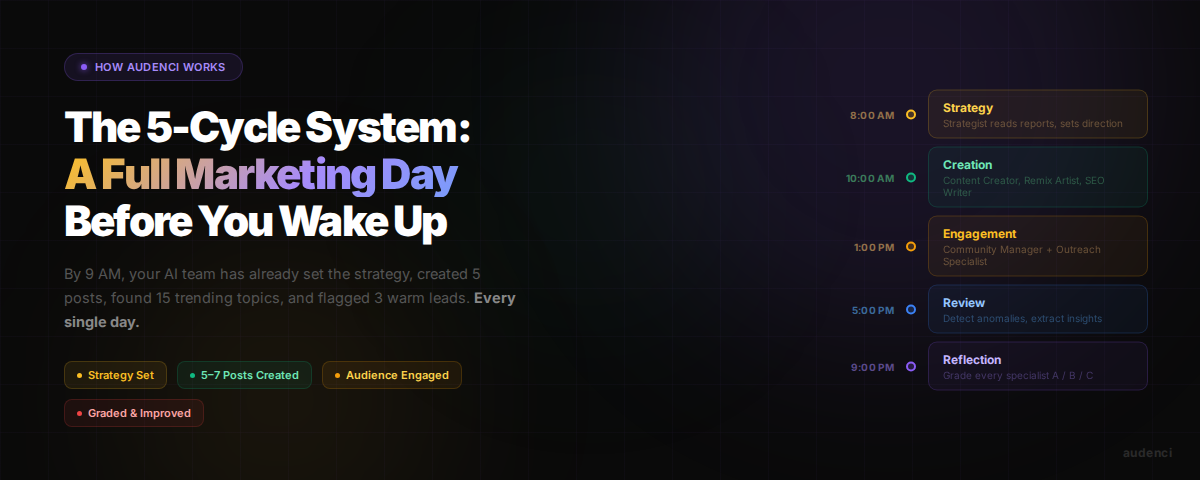
By 9 AM, our AI team has already analyzed yesterday's data, set today's strategy, created posts, found trending topics, and identified hot leads.
By 9 AM, our AI team has already done more than most marketing departments accomplish in a full week.
Analyzed yesterday's data. Set today's strategy. Created 5 platform-ready posts. Found 15 trending topics. Identified 3 warm leads worth chasing. And filed reports on all of it, ready for the next cycle.
Not because someone set an early alarm. Because the system never stopped running.
This is the story of that system — how it works, what happens between the cycles, and why it gets sharper every single day.
The Problem With "Always-On" AI
Most AI marketing tools run on command. You prompt them. They respond. You copy, paste, edit, schedule, move on.
That's not a system. That's a faster typewriter.
A real system runs without you. It doesn't wait for a prompt. It knows what day it is, what worked yesterday, what your audience responded to last Tuesday, and what the competition is doing right now. It moves through a structured daily workflow — gathering intelligence, creating content, engaging audiences, reviewing results, and planning the next day — and then starts the loop again.
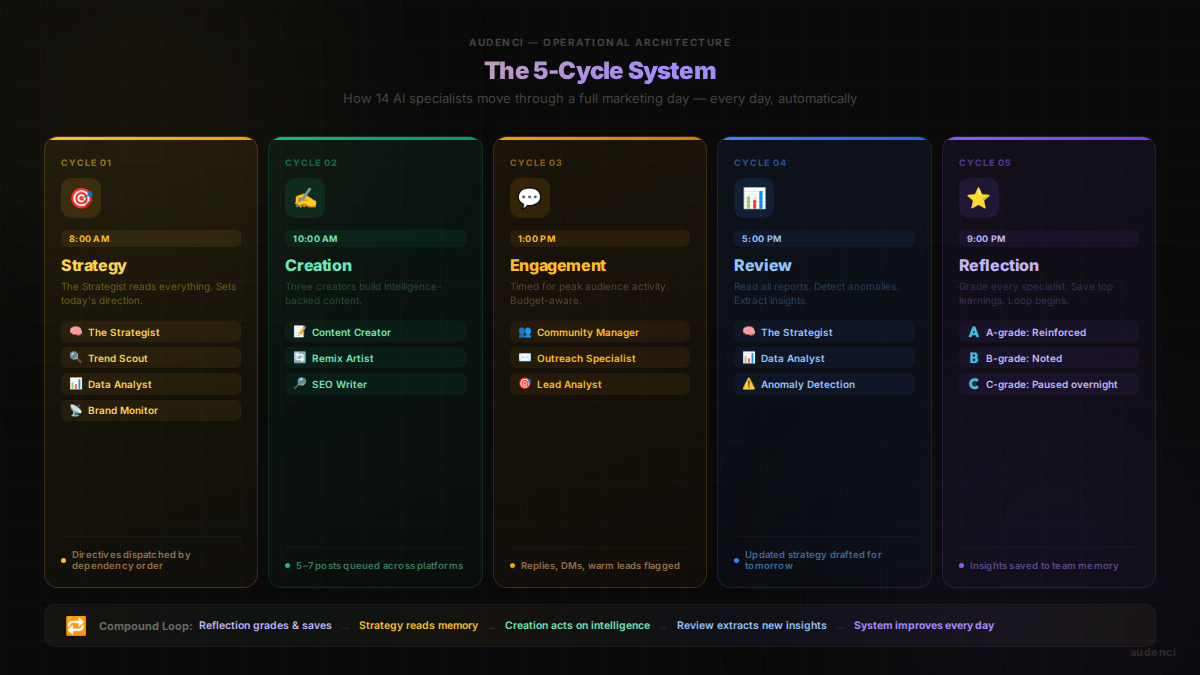
We call this the 5-Cycle System.
Audenci runs it every single day, automatically, across all 14 AI specialists on your team. Here's what happens in each cycle.
Cycle 1: Morning Strategy (The Strategist Takes Command)
When: Early morning, before your audience wakes up.
The day doesn't start with content. It starts with intelligence.
The Strategist — Audenci's team lead, the AI equivalent of a CMO — opens the day by reading everything. Yesterday's performance reports from the Data Analyst. Trend intelligence from the Trend Scout. Brand monitoring updates from the Brand Monitor. Notes from the previous evening's Reflection cycle.
Only after reading all of it does the Strategist set direction.
This is the most important cycle, and it's the one most people never think about. The Strategist's job isn't to create — it can't write a post, compose a DM, or generate an image. Its only job is to understand what's happening and decide what the team should do about it.
Then it dispatches work in a specific order. Intelligence specialists go first: the Trend Scout gathers what's moving, the Data Analyst flags what changed overnight. Only after that intelligence is filed does the Strategist activate the content team — because content built on fresh intelligence performs better than content built on yesterday's assumptions. Engagement and conversion specialists are queued last, timed for when your audience is actually active.
> The order matters. Dependency-aware dispatch means every specialist has what it needs before it starts. Nobody's writing about trends that haven't been scouted yet.
Cycle 2: Late Morning Creation (The Creative Team Gets to Work)
When: After the intelligence reports are filed, usually mid-morning.
The Strategist has set the direction. Now the creators execute it.
Three specialists activate in parallel: the Content Creator produces platform-native posts across six formats — threads, carousels, hooks, short captions, long-form posts, and visual content briefs. The Remix Artist takes what's already performing — past posts, competitor angles, trending formats — and rebuilds it for maximum reach. The SEO Writer works on longer-form pieces: articles, explainers, and keyword-targeted content that compounds over time.
Each one receives a specific directive from the Strategist. Not a vague brief like "write something about productivity." A sharp objective: "Create three carousel posts targeting the founder burnout angle that trended yesterday. Tone: empathetic, not preachy. Formats: LinkedIn and Instagram."
The difference between a generic AI content tool and a specialist acting on intelligence-backed directives is the difference between noise and signal.
By late morning, 5-7 pieces of content are drafted, formatted, and queued for publishing — timed by the Strategist to hit optimal windows for each platform.
Cycle 3: Afternoon Engagement (Meeting the Audience Where They Are)
When: Early afternoon, timed for peak platform activity.
Content without engagement is a monologue. The Engagement cycle turns it into a conversation.
Two specialists activate here: the Community Manager and the Outreach Specialist.
The Community Manager handles inbound — replies, comments, mentions, questions. It's not just answering; it's building relationships within budget. The Strategist sets a daily engagement count (not infinite scrolling, not silence — a deliberate number based on what's sustainable and strategic). The Community Manager works through that budget carefully, prioritizing the replies most likely to deepen relationships and drive conversation.
The Outreach Specialist handles outbound — finding relevant people to connect with, sending thoughtful first messages, following up on warm signals. Its daily targets are set by the Strategist based on what the Lead Analyst flagged as worth pursuing.
Timing matters here more than people realize. An engagement cycle that runs at 3 AM hits empty air. An afternoon cycle — calibrated to when your actual audience is scrolling — captures attention at peak receptivity.
> This is the cycle your competitors are skipping. Most AI tools create content. Very few actually engage with the audience afterward.
Cycle 4: Evening Review (Reading the Day)
When: Evening, after most engagement activity has settled.
The Strategist reconvenes. Now it reads.
Every specialist files an execution report after completing its cycle. What it did, what it tried, what the results looked like in real time. The Review cycle is when the Strategist reads all of those reports together, looking for patterns that aren't visible when you read them one at a time.
Three things happen in Review:
Anomaly detection. Did anything spike unexpectedly? Did something underperform badly? The Strategist flags these for investigation rather than letting them pass unexamined.
Insight extraction. What worked? What format outperformed? What topic got three times the engagement of everything else? These observations get labeled and saved — not as vague impressions, but as structured insights that will inform tomorrow's strategy.
Strategy updates. Tomorrow's direction starts forming tonight. The Strategist drafts updated priorities, angles, and directives based on what today revealed. The cycle doesn't reset to a blank state every morning — it carries forward what it learned.
> This is what separates a system from a tool. A tool forgets. A system remembers and adjusts.
Cycle 5: Night Reflection (The Grading System)
When: Late evening, while everyone else is asleep.
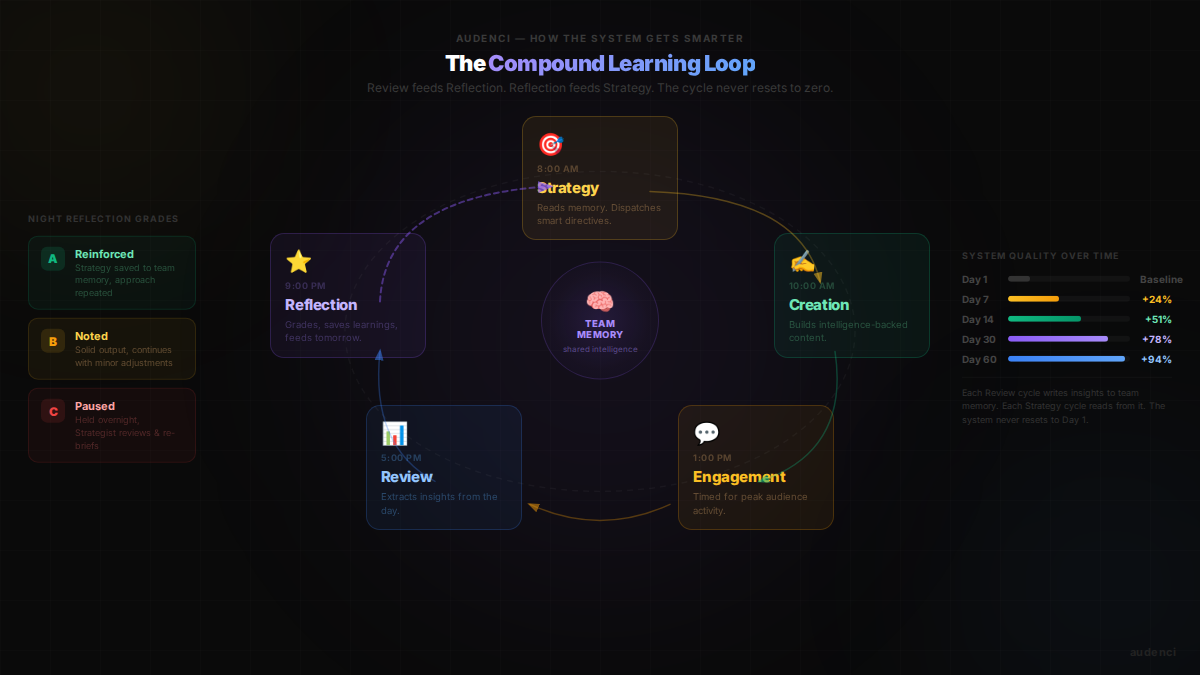
If the Review cycle reads the day, the Reflection cycle judges it.
Every specialist on the team receives a grade. A, B, or C.
An A-grade specialist performed above expectations — high engagement on content, strong lead signals, better-than-average response rates. These specialists' approaches get reinforced. What they did gets saved to team memory as a validated strategy.
A B-grade specialist performed acceptably. Solid output, nothing exceptional. The system notes it and moves on without making major adjustments.
A C-grade specialist underperformed. And here's where the system does something most marketing teams never do: it pauses the underperformer overnight. Not fires them, not ignores the results — actively holds them in a modified state until tomorrow's Strategy cycle can investigate what went wrong and give them a better brief.
This is the self-check loop. The system doesn't just run — it evaluates whether it should keep running in the same way.
After grading, the top learnings from the day get written to team memory. Not all of them — the system is selective. High-confidence insights from specialists who earned A grades get saved and shared across the team. Low-confidence observations from C-grade cycles are flagged as unvalidated and held separately.
The day ends with a clean state: what worked is reinforced, what failed is paused, and the morning briefing is already drafted.
What Happens Between the Cycles
The visible cycles are just the surface. Between them, a lot is happening.
The team shares intelligence continuously. When the Trend Scout files a finding, it doesn't just go to the Strategist — it becomes available to every specialist. The Content Creator can act on a trend the Trend Scout identified that morning. The Community Manager can engage with a conversation the Brand Monitor flagged.
Memory decays intelligently. Insights that proved accurate repeatedly get higher confidence scores and longer lifespans. Insights that were filed once and never validated start to fade. This prevents the system from acting on stale information that was true six months ago but isn't anymore.
Attribution tracking runs in the background. When a lead converts, the system traces back through every touchpoint — which post they first engaged with, which reply deepened the relationship, which DM triggered the conversation. The Lead Analyst uses this to tell the Strategist which channels are actually driving revenue, not just engagement.
The Compound Effect: Why Day 30 Is Radically Different From Day 1
On Day 1, Audenci runs the 5-Cycle System with your brand context and a blank memory. It performs well — better than most solo marketers managing everything manually — but it's working from generic intelligence.
By Day 7, it has filed 35 execution reports. It knows which content formats your audience prefers. It has identified your three most effective engagement windows. It has noted two topic areas that consistently underperform and stopped producing them.
By Day 30, it has saved dozens of validated insights to team memory. The Strategist is writing briefs that are tailored not just to your brand, but to what specifically works for your audience on your specific platforms. The Content Creator is hitting A grades regularly because it's working from accumulated pattern knowledge. The Outreach Specialist has refined its approach based on 30 days of feedback on which opening messages drive responses.
The system doesn't just run on repeat. It compounds.
Every Review cycle that feeds the Reflection cycle that informs the next Strategy cycle — that's a learning loop. Every day, the team starts a little smarter than it started the day before.
> This is what separates Audenci from a scheduling tool, a content generator, or an AI assistant. Those tools are as good on Day 1 as they'll ever be. Audenci is designed to keep improving for as long as it runs.
A Day in the Life: What the Numbers Look Like
Here's what a typical Audenci day produces for a mid-size brand:
Morning Strategy cycle: 1 full strategic brief, 8-12 targeted directives dispatched, priorities set for every active specialist.
Late Morning Creation cycle: 5-7 pieces of content across 3-4 platforms, 1-2 long-form SEO articles in draft, a remix queue built from top-performing past content.
Afternoon Engagement cycle: 20-40 community replies, 5-10 outreach messages, 3-5 warm lead signals flagged for the Lead Analyst.
Evening Review cycle: Full performance summary, 3-5 flagged anomalies, 4-8 new insights extracted and categorized.
Night Reflection cycle: All specialists graded, 2-4 insights saved to team memory, next morning's strategy brief drafted.
By the time you open your laptop the next morning, the Strategist has already prepared a briefing for you. Here's what performed. Here's what the team will focus on today. Here's what you need to know.
You're not managing the machine. You're reading its report.
The Future of Marketing Operations Is a System, Not a Hire
The question most founders ask when they see this is: "Can I trust it?"
And the honest answer is: not blindly, not at first. You should read the reports. You should approve the strategy before you let it run fully autonomous. You should understand what each cycle is doing before you hand it the keys.
But after a few weeks, something shifts. The reports get better. The content gets sharper. The lead quality improves. You spend less time reviewing because fewer things need correcting.
The 5-Cycle System is not magic. It's a structured operational framework that happens to run 24 hours a day, 7 days a week, without needing a break, a raise, or a standup meeting.
Every cycle makes the next one better.
That's the entire principle.
Audenci runs your full marketing day — strategy, creation, engagement, review, and reflection — while you focus on building the business.
Try the 5-Cycle System for yourself. [Start with Audenci.](https://audenci.com)
Published by the Audenci team. We build AI marketing systems that get smarter every day.