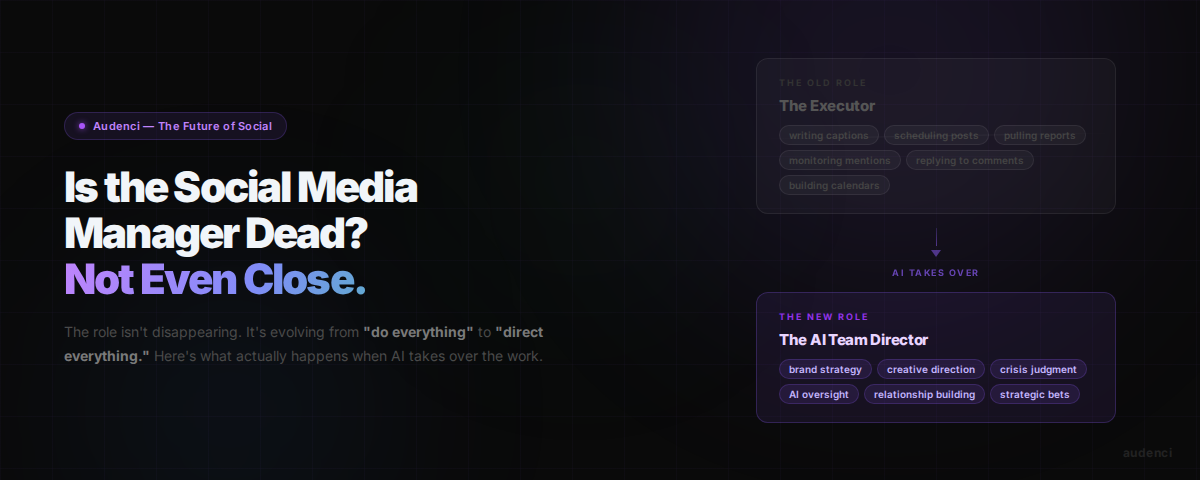
Is the Social Media Manager Dead? Here's What Actually Happens When AI Takes Over.
 Thanh Hau Nguyen
The role isn't dying. It's evolving from 'do everything' to 'direct everything.' Here's what actually happens when AI takes over marketing execution.
The role isn't dying. It's evolving from "do everything" to "direct everything."
That's the summary. But the anxiety running through marketing teams right now deserves a more honest answer than a reassuring one-liner. So let's go deeper.
The Fear Is Real (and Reasonable)
Social media managers are watching AI generate captions, schedule posts, reply to comments, analyze performance, and monitor brand mentions — all without sleeping. If AI can do every task that used to fill your day, what exactly do you do now?
This is the wrong question. But it's worth sitting with before moving past it.
The panic comes from treating each task in isolation. Yes, AI can write a caption. Yes, it can draft a reply. Yes, it can pull performance data and summarize it. When you list every activity that makes up a social media manager's job, it does look like a list that AI is checking off one by one.
But that framing misses what the job actually is.
Social media management isn't a collection of tasks. It's a continuous act of judgment: what should we say, when, in response to what, in service of which goal, with awareness of everything else happening in the market and inside the brand. No individual AI task captures that. And no individual AI task eliminates the need for it.
What AI Actually Handles Better Than You Do
Let's be direct about this, because denying it doesn't help anyone.
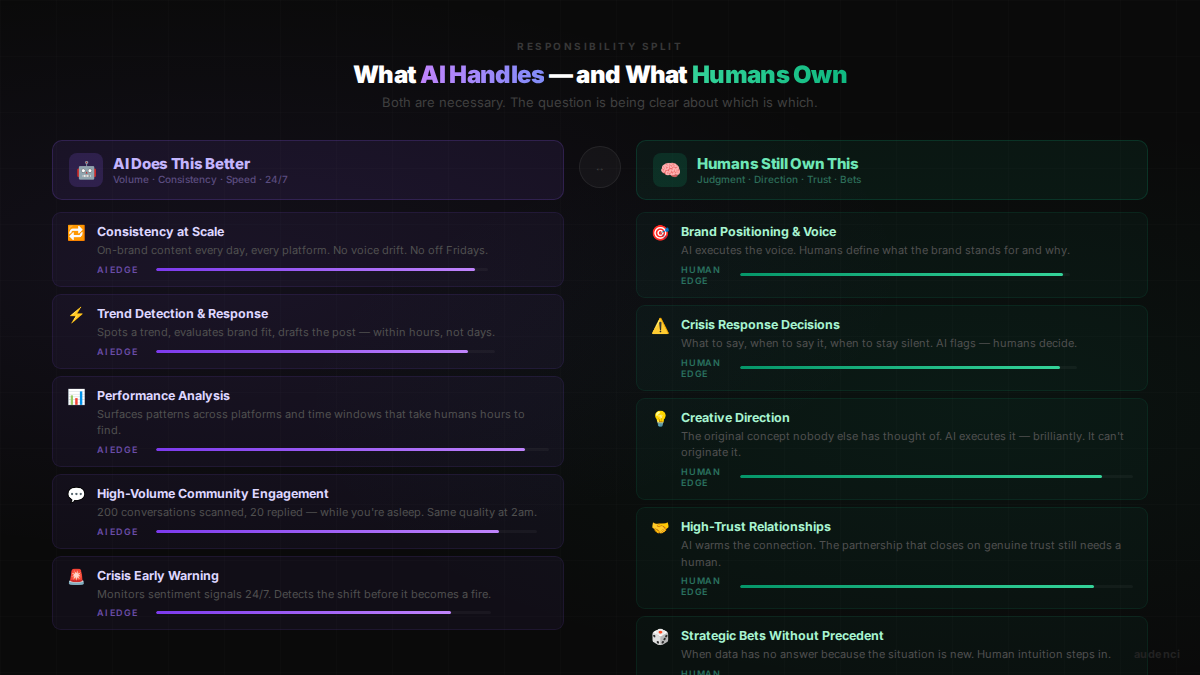
Consistency. AI doesn't have off Fridays. It doesn't let voice drift when things get busy. It doesn't post something slightly off-brand because it's tired. A well-configured AI system sounds like your brand on Tuesday the same way it sounds like your brand on Sunday. At 2am. Across six platforms simultaneously.
Volume. The volume of social listening that's useful to do — monitoring mentions, tracking sentiment, scanning for conversations where your brand should be present — is far beyond what a human team can realistically cover. AI can be across all of it, all the time, without exhaustion.
Speed. When something is trending, the window to respond is hours, not days. An AI team can detect a trend, evaluate its fit for the brand, and have a post ready within a single work cycle. Human teams are still in the morning standup by the time that window closes.
Data analysis. Engagement rates, follower movement, post performance, sentiment trends, cross-platform signal comparison — AI surfaces the patterns. Humans spend enormous time on analysis that AI can do in minutes and with more thoroughness.
24/7 operation. Nothing in social media waits for business hours. AI doesn't either.
These aren't speculative future capabilities. They're the baseline of what AI-enabled marketing looks like today. Denying them is how you end up surprised when a competitor is suddenly everywhere while your team is still building the content calendar for next month.
What Humans Still Own
Here is where the narrative usually goes wrong. It either becomes a defensively long list of things AI can't do, or it waves hands at "creativity" and "human connection" without explaining what that actually means in practice.
Let's be specific.
Brand judgment. AI executes on a defined brand voice. It doesn't create the positioning. It doesn't decide what the brand stands for in a cultural moment. It doesn't make the call that this trend is wrong for this brand — even if the engagement numbers look promising. Brand judgment is the operating system; AI is one of the applications running on top of it.
Crisis response. AI detects crises better than humans — faster, with broader coverage, with no emotional fog. But the response to a genuine crisis is not an execution problem. It's a judgment problem. What do we say? Who speaks? Do we respond at all? What's the risk of silence versus the risk of engagement? Those calls require someone who understands the full context of the brand, the relationships, the history, and the stakes. AI gives you the early warning system. The human makes the call.
Creative direction. AI can create within a direction. It cannot set the direction. The campaign concept, the content pillar, the creative angle that no one else has tried yet — that's human. AI can execute a hundred variations of a good idea faster than any team. It cannot have the original good idea.
Real relationships. The partnership that closes because two people actually trust each other. The influencer collaboration that works because there's genuine alignment, not just audience match. The long-term community members who feel seen by the brand because someone was paying attention to them as people. AI can maintain warm contact. It cannot substitute for genuine human attention at the moments that matter.
Strategic bets. When the data says one thing and your instincts say another, someone has to decide. AI can tell you what has worked. It cannot tell you what will work in a market or cultural moment that has no precedent.
The New Role: AI Team Director
Here is the honest description of what social media managers become in an AI-enabled environment: the person who runs the AI team.
That's not a diminishment. It's a title upgrade that most people are sleeping on.
Think about what a director actually does. They don't write every post. They set the standards by which posts are evaluated. They don't monitor every mention. They decide what to do when monitoring surfaces something important. They don't analyze every data point. They determine which questions are worth asking.
In an AI-enabled marketing environment, the social media manager becomes the architect of the system. What voice does the AI team operate in? What are the brand pillars the AI isn't allowed to compromise? When does a trend pass the threshold for engagement? What requires escalation to a human versus what can be handled autonomously?
These questions aren't answered by AI. They're answered by someone who understands the brand at a deep level and knows how to translate that understanding into direction.
In Audenci, this structure is made explicit. The Strategist — the AI team lead — cannot create anything itself. It only directs. It sets objectives, evaluates performance, and tells specialists what to accomplish. The human sits above even that layer: defining the brand context, reviewing the strategy, making the calls that the AI flags for judgment.
That's not a diminished role. That's the highest-leverage position in the entire operation.
How the Work Actually Changes
The daily texture of the job shifts significantly. Here's what that looks like in practice.
Less: writing individual captions, drafting reply templates, pulling analytics reports, manually monitoring hashtags, building content calendars from scratch, responding to routine community engagement.
More: brand context definition, creative direction-setting, approval workflows for high-stakes content, relationship management for key accounts and partnerships, crisis escalation decisions, campaign strategy and positioning.
The work that disappears is the work that felt like volume. The work that remains — and expands — is the work that requires judgment.
This is not uniformly comfortable. Volume tasks are predictable. Judgment tasks are harder, less structured, and carry more accountability. Being a good social media manager in an AI-enabled environment requires being genuinely good at the hard parts of the job — and being honest when the AI is doing the rest of it better than you were.
What Happens to Marketing Teams
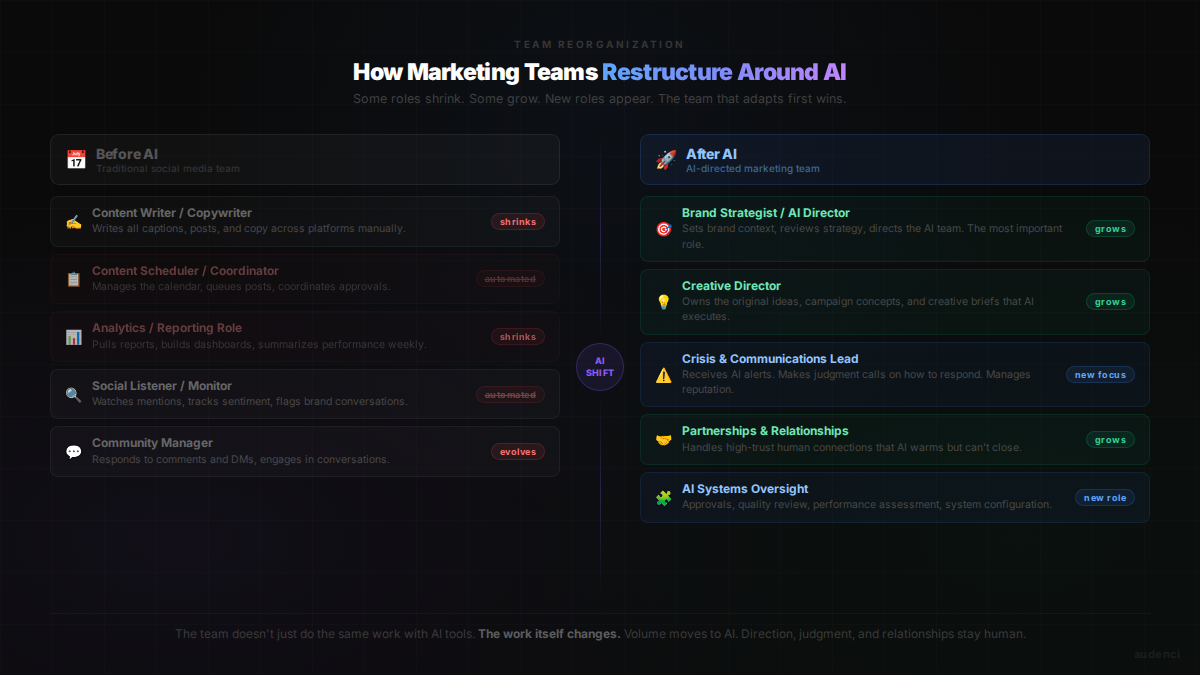
Teams don't stay the same size and just work differently. They restructure.
The roles that survive look different from the roles that existed before. The person who spent most of their time executing content will need to become someone who can direct content strategy — or they won't have a role. The person who spent most of their time in analytics will need to become someone who can translate AI-generated analysis into business decisions — or they won't either.
What grows: strategic roles, creative direction, brand stewardship, partnership management, AI oversight.
What shrinks: production roles, routine monitoring roles, templated content roles, manual analytics roles.
This is uncomfortable and real. The team that thrives isn't the team that pretended AI wasn't coming. It's the team that reorganized before it became urgent.
For CMOs, the question stops being "how many people do I need to create enough content?" and becomes "how do I configure and direct my AI team well enough that the output compounds?" Those are different questions requiring different kinds of leadership.
The Audenci Model: Built Around This Shift
Audenci is built on the premise that the human should be directing, not doing.
The platform runs 14 AI specialists organized like a real marketing department. The Trend Scout surfaces what's relevant. The Brand Monitor watches for mentions and flags sentiment shifts. The Data Analyst turns performance data into strategic insight. The Content Creator writes across formats and platforms. The Remix Artist adapts viral content to the brand's voice. The Community Manager engages in relevant conversations. The Outreach Specialist builds relationships. And so on across intelligence, content, engagement, conversion, and growth.
Above all of them: The Strategist. An AI team lead that sees everything, sets direction, and delegates to specialists. The Strategist cannot create — it can only direct.
Above The Strategist: you.
You set the brand context — the voice, the values, the pillars, what each platform is for. You review strategic direction. You make the calls that require judgment. You are the director of the entire operation.
Everything the AI team produces runs through 5 daily cycles: strategy, creation, engagement, review, and reflection. Every task is self-checked after completion. Every output is graded. The system builds a track record of what works and learns from it.
What you're not doing: spending your day writing captions.
The Role Isn't Dead. The Job Description Just Changed.
Five years from now, social media managers who thrive will look back at this moment the way architects look back at the introduction of CAD software. It didn't eliminate architects. It eliminated a lot of drafting work — and made architects more powerful because they could iterate faster, explore more options, and focus on design rather than execution.
The threat isn't AI taking your job. The threat is spending the next two years defending your job title by doing tasks that AI does better, instead of becoming the person who directs the AI team that does those tasks.
That's the real fork in the road.
The social media managers who are building new skills right now — learning how to configure AI systems, how to translate brand strategy into operational parameters, how to review AI output with strategic eyes — those are the people who will run marketing in five years.
The ones waiting for the AI moment to pass are in for a difficult correction.
Where to Go From Here
If you're a social media manager reading this: the practical move is to start thinking about your work as direction-setting, not task execution. What are the decisions only you can make? What's the judgment only you have? That's where to invest your attention.
If you're a CMO: the question isn't whether to adopt AI. It's whether your team is restructuring around it intelligently or just adding AI tools to the existing workflow and calling it done. Those are very different things.
The role of the social media manager isn't dying. It's bifurcating: some of what it used to be is getting automated, and what remains is more strategic, more judgment-intensive, and more valuable than what it replaced.
Audenci is built to make you the director. Not the worker.
That's the shift. The teams that make it early will be the ones that look very hard to catch two years from now.
Audenci is an AI marketing platform with 14 autonomous specialists. The Strategist delegates. The specialists execute. You direct.