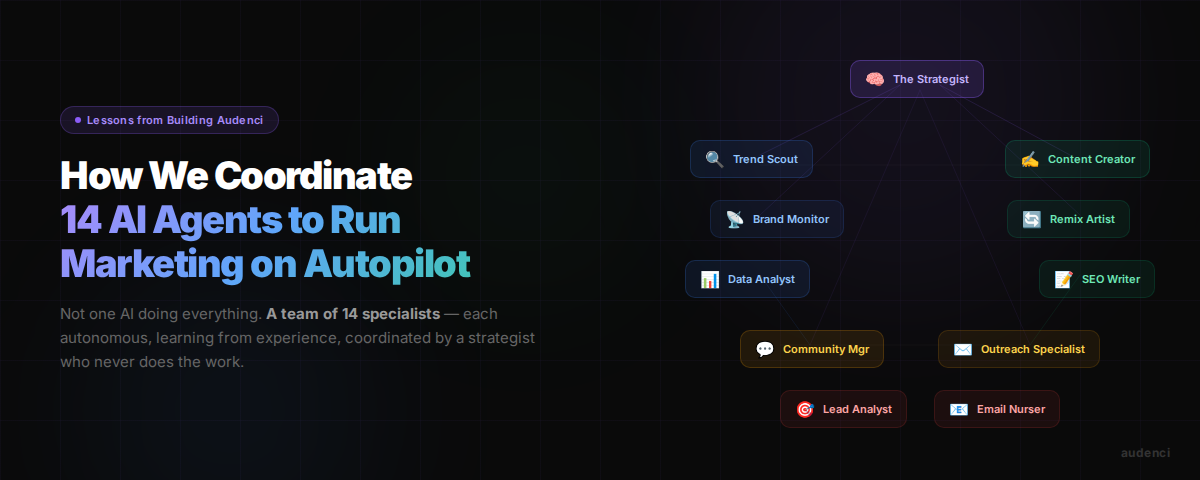
Lessons from Building an AI Marketing Team: How We Coordinate 14 Autonomous Agents to Run Marketing on Autopilot
 Thanh Hau Nguyen
How we coordinate 14 autonomous AI agents to run marketing on autopilot — the architecture, the lessons, and why the leader must never do the work.
Marketing has a scaling problem.
One person cannot simultaneously monitor trending topics, create platform-specific content, engage with comments across five social networks, send personalized DMs, score leads, nurture them through email sequences, run analytics, write SEO blog posts, manage ad campaigns, and coordinate influencer outreach.
That is 13 different specialties. Most teams hire 5-10 people to cover them. Most solo founders pick 2-3 and ignore the rest.
When we started building Audenci, we tried the obvious thing first: one big AI agent that could do everything - generate content, reply to comments, send DMs, analyze metrics, all in one brain.
It was a disaster.
The agent got confused. It would start analyzing metrics halfway through writing a caption. It mixed up engagement strategy with content strategy. When something went wrong, we had no idea where the failure came from.
Then we asked: how do real marketing teams work?
They don't have one person doing everything. They have specialists - a content creator, a community manager, a data analyst, a growth marketer - coordinated by a team lead who sets direction and delegates. Each person owns their domain and makes their own decisions within it.
So that's what we built. Not one AI. A team of 14.
What is an AI Marketing Team?
An AI marketing team is not a chatbot. It is not a single AI assistant that answers marketing questions. It is a team of AI specialists organized exactly like a real marketing department.
At the top sits The Strategist - think of it as the CMO. It sees everything: performance data, trends, what each team member is doing, what's working and what's not. It sets direction and delegates work. But here is the critical part: The Strategist cannot create anything. It cannot write captions, compose DMs, or design posts. It can only direct the team.
This is the single most important design decision in Audenci. Without it, the whole system collapses back into one overwhelmed agent trying to do everything.
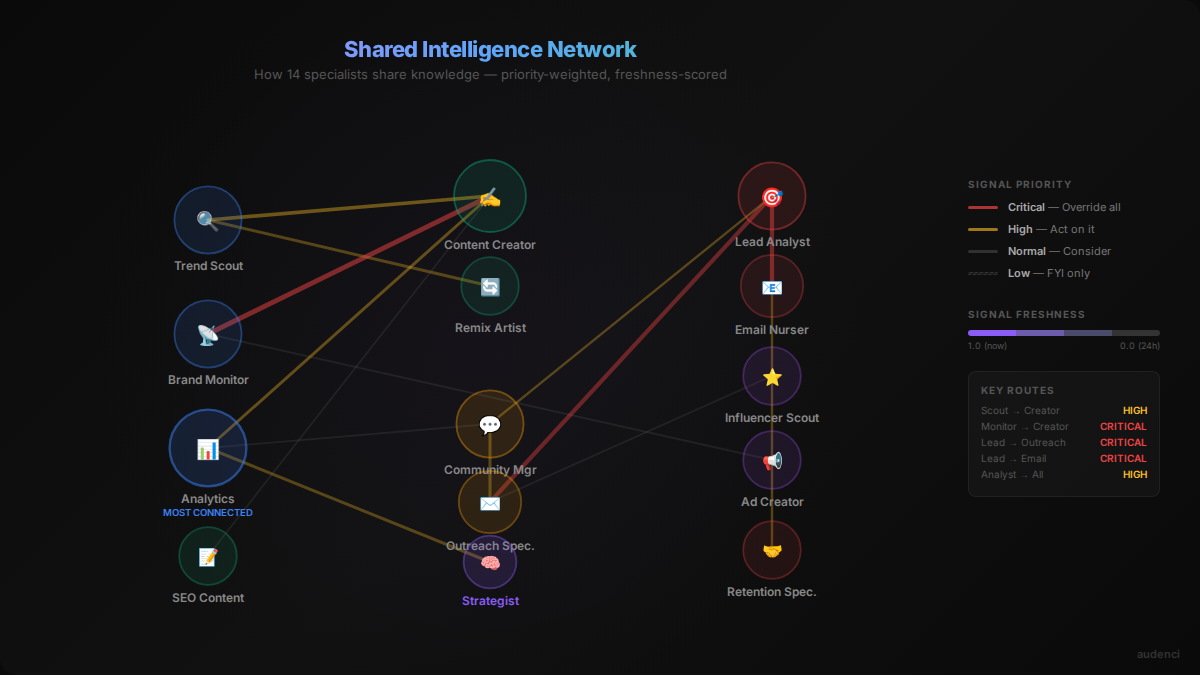
Below The Strategist sit 14 specialists, organized into five groups:
Each specialist is a fully autonomous AI agent with its own skills, its own memory of what has worked before, and its own decision-making. When The Strategist tells The Content Creator to "create engaging posts about summer trends," The Content Creator decides the format (carousel vs. reel vs. story), the hook, the caption, the hashtags, and the CTA - all on its own.
The Strategist tells specialists what to accomplish. Specialists decide how.
How It Works
Audenci runs on a simple two-level structure.
Level 1: The Strategist has a bird's-eye view of the entire operation. It can check how every specialist is performing, read analytics reports, discover trending topics, launch campaigns, dispatch tasks to any of the 14 specialists, read their work reports, and adjust direction on the fly.
Level 2: The Specialists each have a focused set of capabilities tied to their domain. The Content Creator can research trends, check brand guidelines, review recent performance, and draft posts. The Community Manager can search for relevant conversations across platforms, evaluate which ones are worth engaging with, and craft replies. Each specialist only sees what's relevant to their job.
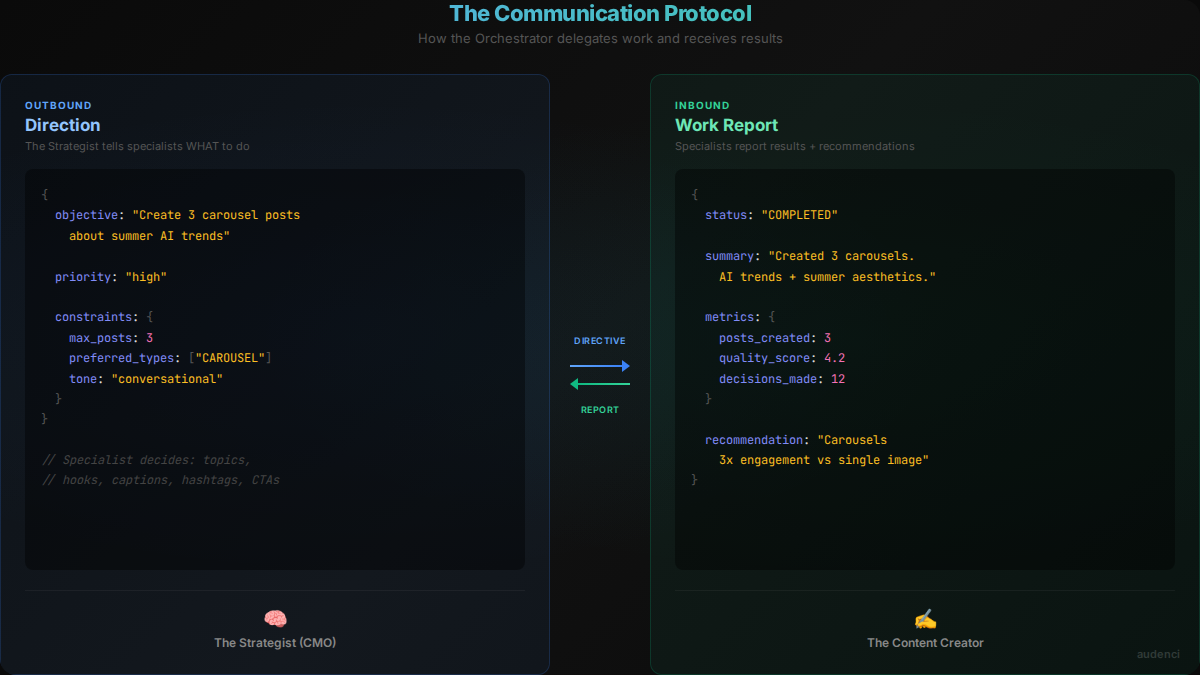
The two levels communicate through a clean back-and-forth:
Direction (Strategist → Specialist): "Find and engage with 10 relevant posts about AI tools. Avoid promotional tone. Prefer Reddit and Twitter."
Report (Specialist → Strategist): "Engaged with 12 posts. Generated 34 replies. Detected 3 high-potential leads. Recommendation: Reddit threads about productivity tools are getting the strongest responses."
This separation is what makes the system trackable. When engagement drops, you check The Community Manager's reports. When content quality drops, you look at The Content Creator's decisions. Every specialist's reasoning is logged.
After every task, each specialist also runs a self-check - evaluating the quality of its own work, flagging anything that seems off, and saving lessons for next time. It's a small step that catches mistakes before they snowball.
The Team Roster
After months of iteration, we settled on 14 specialists. Here is what each one does and why they matter.
The Intelligence Team
The Trend Scout is the team's eyes on the internet. It evaluates every trend across five angles: how well it fits the brand, how much the target audience cares, whether it's rising or fading, whether the brand can add unique value, and how crowded the topic already is. It also classifies trends by how long they'll last - some demand a post within 24 hours, others deserve a content series over weeks.
The Brand Monitor tracks mentions of your brand across social platforms, news sites, and forums. It watches sentiment and has built-in crisis detection - when negative chatter spikes, it raises an alarm immediately. Think of it as the team's early warning system.
The Data Analyst turns raw numbers into strategic insight. It doesn't just report that engagement was 5.2% this week. It tells you that's exceptional compared to benchmarks, that carousel posts drove most of it, that Tuesday mornings outperformed everything else, and that one post went semi-viral because it rode a trending topic the Trend Scout caught two days earlier.
The Content Team
The Content Creator is the creative workhorse. It handles six content formats - image posts, carousels, reels, video, text-only, and stories - with settings customized per social account. Your Instagram can get polished carousels while your Twitter gets punchy text posts. It reads trending topics, recent performance, and brand guidelines before deciding what to create, then produces the full package: caption, hook, hashtags, and call to action.
The Remix Artist finds viral content across the internet and adapts it for your brand. Not copying - reimagining. It scores each piece of viral content for brand fit and viral potential, then decides how closely to follow the original: a close adaptation, a modified concept, or just loose inspiration. It tracks what it's already remixed to keep things fresh and varied.
The SEO Writer researches keywords, analyzes what people are actually searching for, and writes blog posts optimized for organic discovery. It feeds keyword insights back to the rest of the team so social content can reinforce the same topics.
The Engagement Team
The Community Manager is in charge of social engagement. It searches for relevant conversations across Twitter, Reddit, TikTok, and Instagram, then evaluates each one - is this post relevant enough to our brand to be worth replying to? Only the best matches get a response, and that response is crafted to match each platform's culture. Twitter replies are short and punchy. Reddit replies are thoughtful and community-aware. TikTok comments match the energy.
The Outreach Specialist builds one-to-one relationships through personalized direct messages. It follows a natural progression: start warm, lead with value, then gently introduce a call to action. Every message is kept short to feel human. It prioritizes who to message based on how engaged they've been - the most interested people get attention first - and always checks past conversation history to avoid repeating itself.
The Conversion Team
The Lead Analyst goes beyond simple scoring. It evaluates how quickly someone's engagement is growing, whether they're interacting across multiple channels, how recently they've engaged, whether their interest is steady or sporadic, and whether they're showing buying intent. It monitors the overall pipeline health - is the mix of cold, warm, and hot leads where it should be? - and flags when something looks off.
The Email Nurser manages drip campaigns that guide leads from first touch to conversion. It follows a proven structure: welcome, educate, share a case study, add social proof, make a soft ask, then a direct offer. The sequence adapts based on how warm the lead is - cold leads get education, hot leads get social proof and offers. It also picks the best time to send each email based on when that person is most likely to open it.
The Retention Specialist watches for signs of customer churn - decreasing engagement, longer gaps between interactions, reduced spending. It segments customers by risk level and creates targeted win-back campaigns before they leave.
The Growth Team
The Ad Creator generates ad copy and creative concepts across platforms, suggests target audiences based on who's already engaging with the brand, and tracks campaign performance. It creates multiple variations for testing.
The Influencer Scout finds creators who match the brand's niche and audience, evaluates their profile quality and authenticity, and drafts personalized outreach messages that The Outreach Specialist can send.
How They Coordinate
Fourteen autonomous specialists would be chaos without coordination. Three systems keep them working as a team.
Shared Intelligence
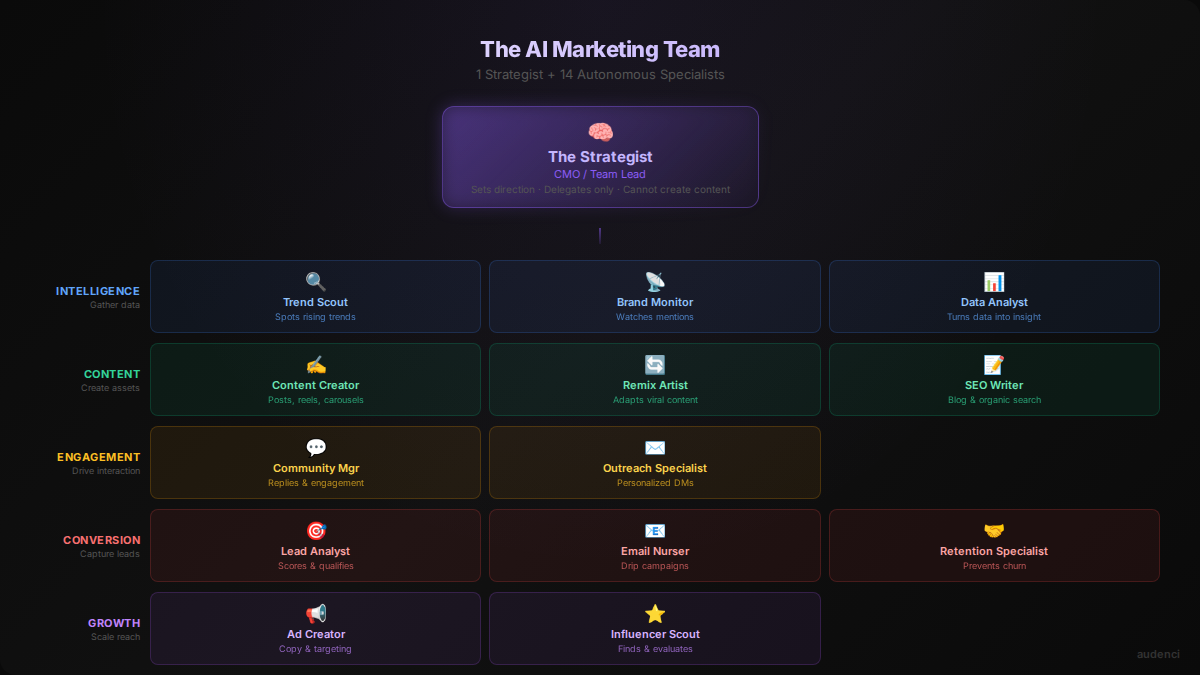
Before every task, each specialist receives relevant updates from their teammates. The Content Creator gets briefed by The Trend Scout, The Data Analyst, The Community Manager, The Brand Monitor, and The SEO Writer. The Outreach Specialist gets briefed by The Lead Analyst, The Community Manager, and The Influencer Scout.
Each update carries a priority (critical, high, normal, low) and a freshness score that fades over 24 hours. A critical alert from The Brand Monitor ("negative sentiment spike detected") overrides everything. A low-priority note from The Data Analyst ("carousels slightly outperform images") informs but doesn't redirect.
This prevents information overload. Without priority and freshness, specialists would treat yesterday's stale data the same as breaking news.
Attribution Tracking
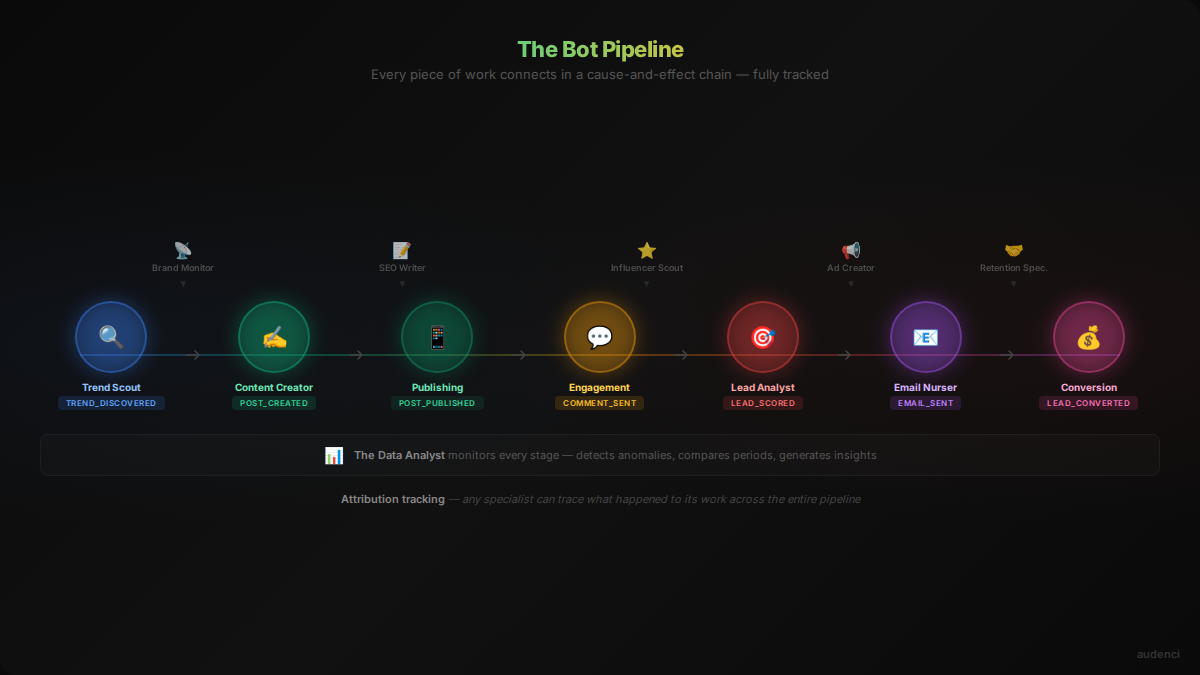
Every piece of work in Audenci is connected in a cause-and-effect chain: trend discovered → post created → comment sent → lead scored → email sent. Each step is recorded.
Any specialist can look back and see what happened to its work. The Trend Scout can check: "That AI ethics trend I flagged last week - did it lead to any posts? Did those posts generate engagement? Did that engagement produce any leads?"
This is what enables real ROI tracking. Not vanity metrics like "we posted 50 times this week." Actual attribution: "this trend discovery led to 3 posts that generated 2 qualified leads."
Daily Cycles
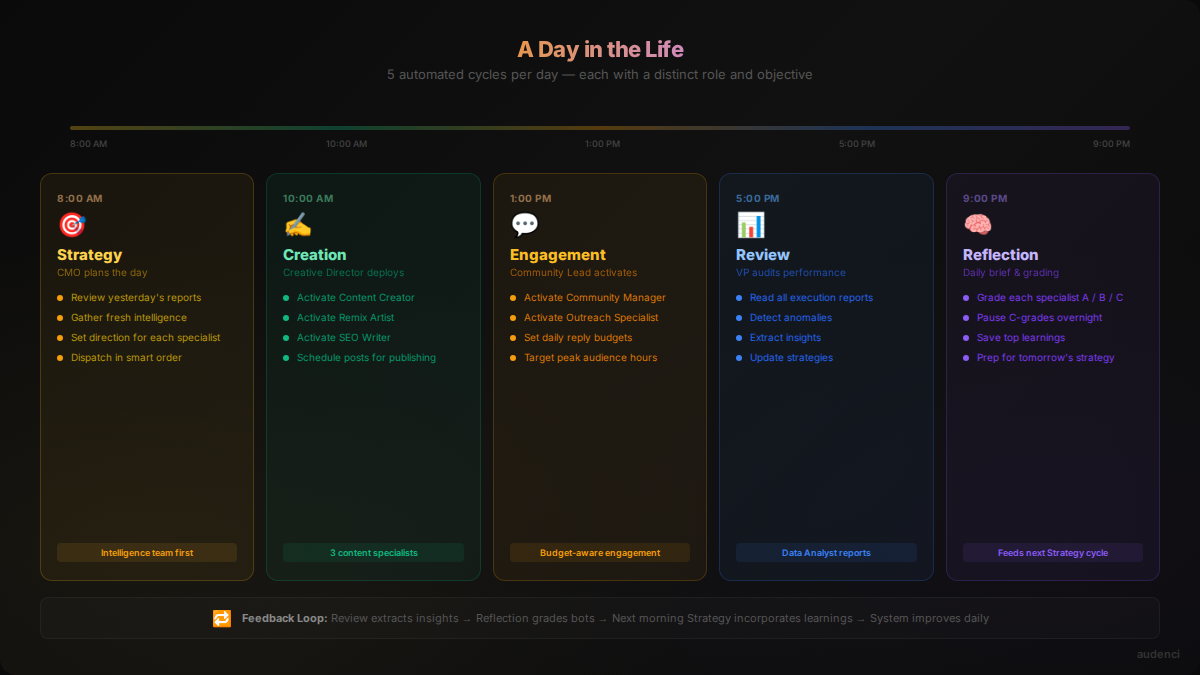
The Strategist runs five automated cycles each day:
Morning - Strategy. Review yesterday's performance, read all specialist reports, gather fresh data, and set the day's direction. Dispatch work in dependency order: intelligence first (gather data), then content (create based on intelligence), then engagement (drive interaction), then conversion (capture leads).
Late Morning - Creation. Deploy The Content Creator, The Remix Artist, and The SEO Writer with specific objectives based on the morning strategy.
Afternoon - Engagement. Activate The Community Manager and The Outreach Specialist with daily budgets and target counts, timed for when audiences are most active.
Evening - Review. Read everything that happened. Detect anomalies. Pull out insights. Update strategies for tomorrow.
Night - Reflection. Grade every specialist's performance (A, B, or C). Pause underperformers overnight so they don't waste resources. Save the day's top learnings to team memory.
The key: Review feeds back into Strategy. Each morning starts smarter than the last. This is what makes the system improve over time instead of just running on repeat.
The Memory System
Without memory, every cycle starts from zero. With memory, your AI team builds institutional knowledge - just like a real team does.
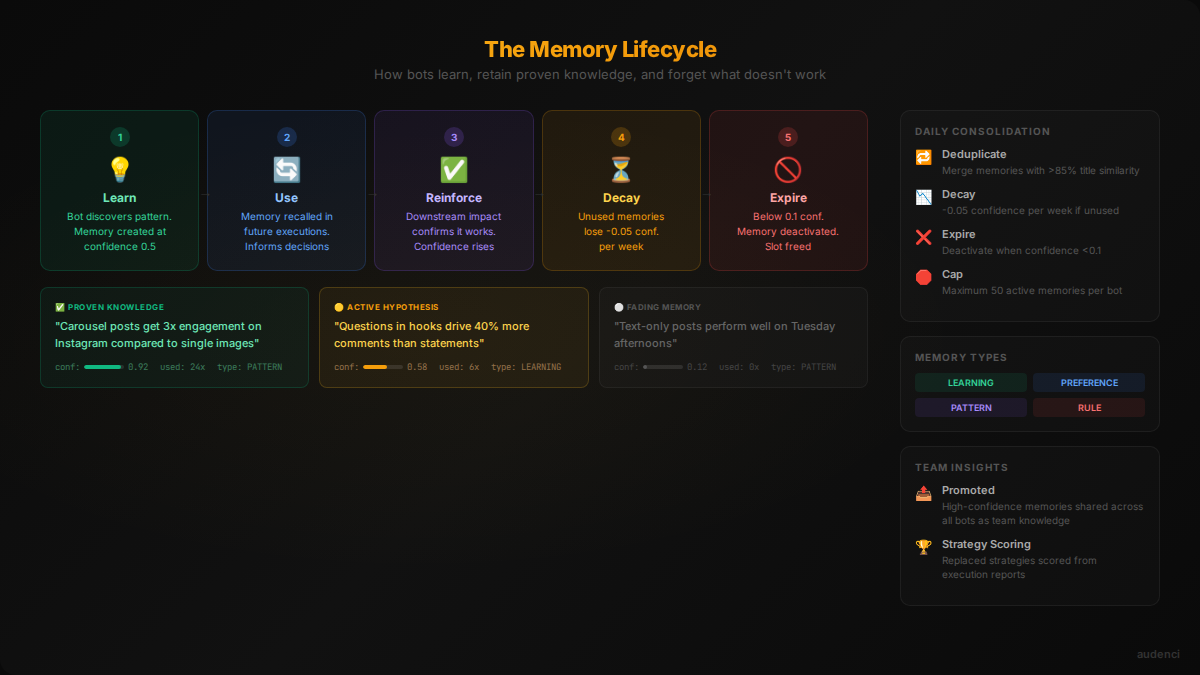
Every specialist in Audenci can remember what worked, recall past learnings, and update its knowledge when new evidence comes in. These aren't vague notes - they're specific, typed, and scored.
A memory might be: "Carousel posts get 3x engagement on Instagram" (high confidence, used 24 times, proven). Or: "Questions in hooks drive more comments than statements" (medium confidence, still being validated). Or: "Text-only posts work on Tuesday afternoons" (low confidence, fading because it hasn't been confirmed).
But here is the critical lesson: memory must decay.
Without decay, specialists accumulate stale knowledge that poisons future decisions. A learning from two months ago - "text posts are trending" - might be completely wrong today. So the system automatically:
This keeps everyone's knowledge base lean and current. Proven insights survive. Unvalidated hunches fade naturally.
Beyond individual memory, Audenci maintains shared team knowledge. When The Data Analyst discovers that carousel posts dramatically outperform single images, that learning gets shared with The Content Creator and The Remix Artist. When The Community Manager learns that Reddit engagement peaks on weekday mornings, The Strategist gets that insight for scheduling decisions.
The Strategist also grades strategies over time. When a strategic direction is replaced, the old one gets scored based on what the team accomplished while following it. Over time, the system builds a track record of what approaches worked and which didn't - and avoids repeating past mistakes.
Cloud Phones & Account Warmup
Social media APIs only let you do so much. You can post content and read metrics, but you can't scroll a feed, watch stories, or interact with content the way a real person does.
Audenci integrates with cloud phones - real mobile devices running in the cloud that behave like a real person would. They scroll through feeds, like posts, follow accounts, and navigate apps with natural timing.
But the most important lesson we learned here was about patience.
New social accounts that immediately start posting automated content get flagged by platform algorithms. We learned this the hard way - we lost multiple accounts before building a warmup system.
Now, every new account goes through a warmup phase. For the first few days, the account only does what a real new user would: scrolling, liking, following, watching stories. No posting. No commenting. No DMs.
The cloud phone runs 1-3 natural browsing sessions per day at varied times. Only after the warmup period ends does the account start actively posting and engaging.
This mirrors what experienced social media managers do instinctively. Audenci just automates it.
Lessons Learned
After building and running this system, these are the lessons that would have saved us the most time if we'd known them upfront.
1. The Leader Must Not Do the Work
The most important design decision in Audenci is that The Strategist cannot create content, write messages, or produce any marketing material. It can only direct others.
Remove this constraint and the whole system falls apart. The Strategist starts writing mediocre captions instead of delegating to The Content Creator. It tries to reply to comments instead of dispatching The Community Manager. It becomes one overwhelmed generalist - exactly the problem we were trying to solve.
The constraint forces delegation. And delegation means each specialist brings its full expertise to the job.
2. Tell the Team WHAT, Not HOW
Giving specialists objectives - "engage with 10 relevant posts about AI tools, prioritize quality" - instead of step-by-step instructions - "search Twitter for X, then evaluate each result, then write a reply" - produces dramatically better results.
With objectives, specialists make creative decisions we never anticipated. With instructions, they follow scripts rigidly and miss opportunities.
3. Memory Must Fade
Without decay, specialists accumulate stale knowledge that degrades their decisions. We tried unlimited memory first. Within a month, specialists were carrying contradictory lessons from different time periods. Decision quality dropped visibly.
Automatic fading of unused memories, plus a hard cap per specialist, solved this completely.
4. Not All Intelligence Is Equal
A critical alert - "customer crisis on Twitter" - must override a low-priority observation - "engagement slightly higher on weekends." And a trend spotted an hour ago carries more weight than one from yesterday.
Without priority and freshness scoring on shared intelligence, specialists treat all information equally. That leads to confused decisions and missed urgency.
5. Watch Your Budget
Every cycle checks the resource balance before dispatching work. The Strategist adjusts targets based on what's left - if resources are running low, it scales back to essentials only.
We learned this after burning through an entire day's budget in the morning, leaving nothing for afternoon engagement when audiences are most active.
6. Let Specialists Grade Their Own Work
One quick self-check after every task - did I follow the brief? Did I miss any constraints? What should I remember for next time? The cost is negligible. The value is enormous: it catches mistakes before they compound.
A Content Creator that produced off-brand content once will reflect on why, save a lesson, and avoid the same mistake next time. Without self-checking, it would repeat the error every cycle.
7. Track Cause and Effect
Without connecting the dots - trend discovery to content creation to engagement to lead scoring to conversion - you cannot measure what actually drives results. You're left with vanity metrics ("we posted 50 times this week") instead of attribution ("this trend led to 3 posts that generated 2 leads").
Attribution tracking turns an automation system into an optimization system.
8. Warm Up Before You Automate
New social accounts need to build reputation before automation kicks in. Organic behavior first (scrolling, liking, following), automated actions second (posting, commenting, DMing). We lost accounts before learning this.
This applies beyond social media. Any system that interacts with external platforms should start slow and build trust before scaling up.
Conclusion
The future of AI in marketing is not a single chatbot answering questions. It is an autonomous team - specialists who own their domains, a strategist who sets direction, and feedback loops that build knowledge over time.
Building Audenci taught us that the hard problems aren't about making any single AI smarter. They are about coordination: how specialists communicate, how they share intelligence, how they learn from experience, and how you measure what's actually working.
These patterns - separating strategy from execution, giving objectives instead of instructions, building memory that fades, sharing intelligence with priority scoring, tracking cause and effect - apply far beyond marketing. They are the building blocks of any AI system that needs to get better over time.
If you're building something similar, start with the constraint: the leader cannot do the work. Everything else follows from there.
We're still learning. Every week, our specialists discover patterns we didn't expect, and every cycle refines the system a little more. That's the point - you don't build an AI team that's perfect on day one. You build one that improves on day two.