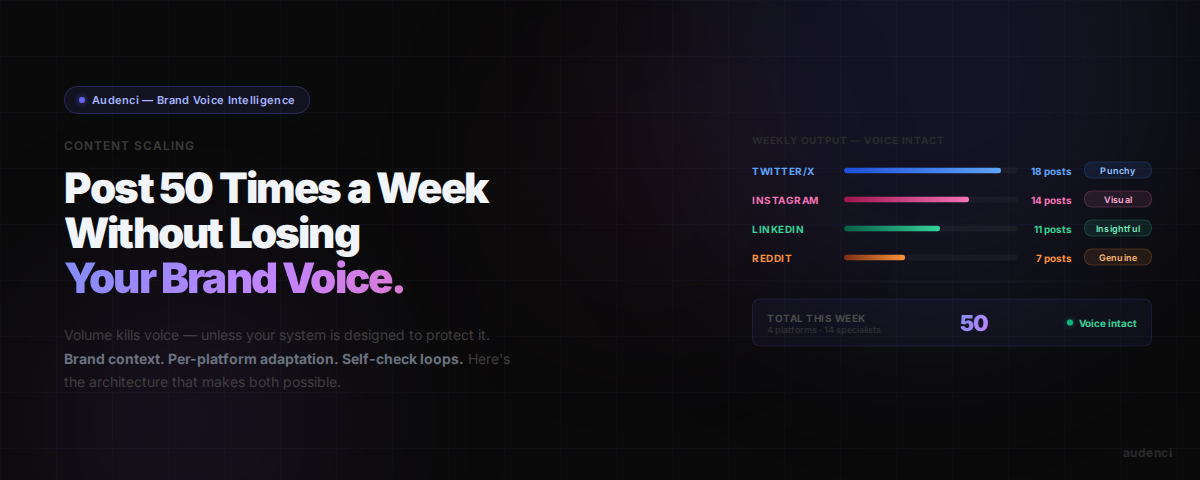
How to Post 50 Times a Week Without Losing Your Brand Voice
 Thanh Hau Nguyen
Volume kills voice. Unless your system is designed to protect it. How brand context, self-checks, and approval queues scale content without compromise.
Volume kills voice.
Unless your system is designed to protect it.
Every brand that's tried to scale content output has felt this. You hire a VA, bring in a freelancer, start using an AI tool — and the posts start coming out. More of them. Faster. But something quietly changes. The tone drifts. The word choices get generic. The personality that made your audience follow you in the first place starts sounding... borrowed.
By post 30, you don't sound like you anymore.
This is the core content scaling problem. And it's not solved by telling people "stay on brand" or by writing a style guide no one reads. It's solved by architecture — a system where brand voice isn't a reminder. It's a constraint that runs before every single piece of content gets created.
Here's exactly how that works.
The Volume Problem Nobody Talks About
Posting frequency requirements are brutal.
Twitter/X rewards creators who show up multiple times a day. LinkedIn penalizes low-volume accounts with reduced reach. Instagram carousels, threads, stories, Reels — each platform has its own cadence, and missing any of them means falling behind.
The brands that win at content aren't posting better. They're posting more consistently, more frequently, and across more surfaces than everyone else.
But here's what those numbers actually mean at scale: if you want 50 posts per week across platforms, that's 7 posts per day, every day. No sick days. No creative blocks. No holidays.
At that volume, the human bottleneck doesn't just slow you down. It changes your output. Fatigue affects tone. Speed sacrifices nuance. The third post on a Tuesday afternoon doesn't sound like the first post on a Monday morning.
The answer isn't to post less. The answer is to stop relying on human energy to maintain consistency — and start relying on a system.
What "Brand Voice" Actually Means as a System Input
Most brand guidelines are documents. PDFs that live in shared drives. Long paragraphs about mission and values. Adjectives that describe personality ("warm but authoritative," "playful but professional").
None of that is usable by a machine trying to write a tweet at 3am.
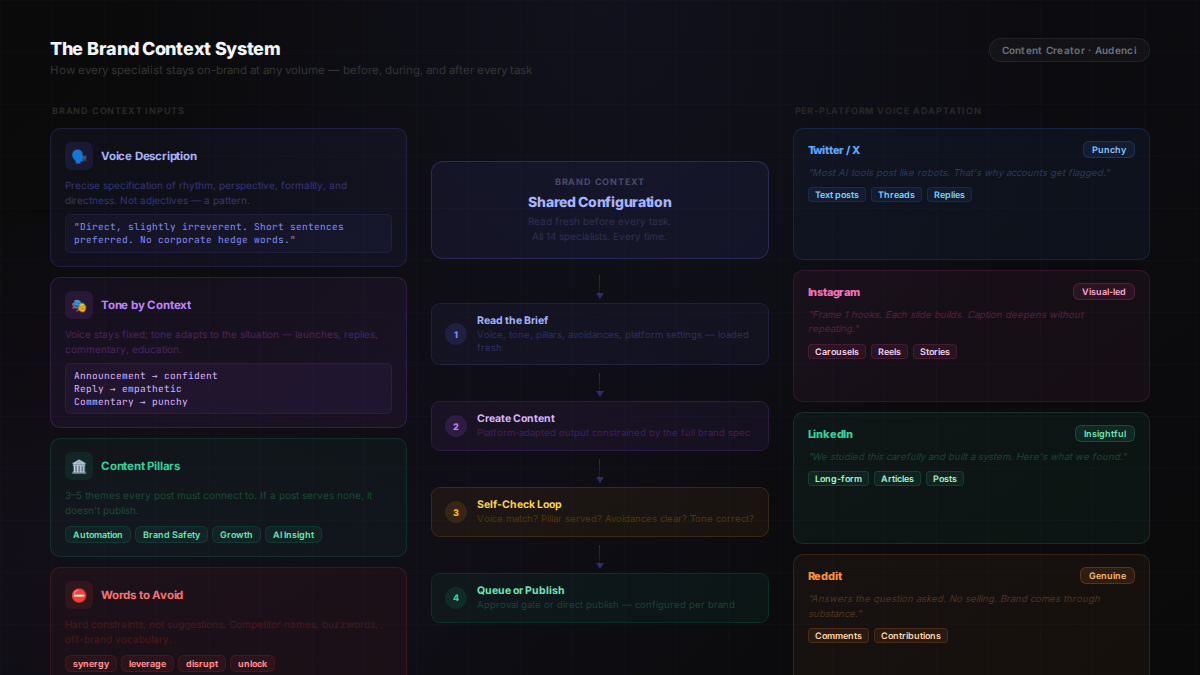
The brand context system treats voice as a structured set of rules — not a description, but a specification. It includes:
Voice description. Not "we're friendly." Something precise: the rhythm, the perspective, the level of formality, the type of humor if any, the level of directness.
Tone. Which varies by situation. Announcing a product? Responding to a complaint? Joining a cultural conversation? Voice stays consistent; tone adapts.
Content pillars. The 3–5 themes every piece of content should connect back to. If a post doesn't serve any pillar, it doesn't get published — no matter how clever it is.
Words and phrases to avoid. This is the one most brands skip, and it's often the most important. Every brand has vocabulary that's off-limits: competitor names, overused buzzwords, industry clichés, terms that conflict with brand positioning. These live in the system as constraints, not suggestions.
Per-platform settings. Instagram audiences expect visual context; Twitter audiences want punchy standalone statements; LinkedIn audiences respond to professional insight; Reddit communities demand genuine participation. The same idea gets expressed differently on each platform — same brand, different voice expression.
This isn't a document. It's a configuration. And every specialist in Audenci reads it before it does any work.
How Every Specialist Reads the Brief
The Content Creator doesn't improvise.
Before generating any piece of content — a carousel, a text post, a Reel script, a story — it reads the full brand context. Voice description. Active tone for the current situation. Relevant content pillars. Forbidden vocabulary. Platform-specific settings.
Only then does it create.
This isn't a one-time setup. It happens before every task. The same brief that governed the first post governs the hundredth. There's no "I think I know this brand by now" drift. The constraints are reloaded fresh every single time.
The Remix Artist does the same thing — but with an additional layer. It doesn't just read brand guidelines; it also tracks what it's already adapted. No repeating the same viral hook twice. No cycling back to the same framing. The brief includes recent history, so variety is preserved alongside voice consistency.
The Community Manager reads brand guidelines before writing any reply. A reply on Reddit sounds different from a reply on Twitter — but both stay unmistakably on brand, because both start from the same source.
Fourteen specialists. One brand context. Every task.
Per-Platform Voice: Same Brand, Different Register
Here's a real example of how voice adapts by platform without fracturing.
Say you're a B2B SaaS brand. Your voice is direct, no-nonsense, slightly irreverent. You care about respecting your audience's intelligence.
On Twitter/X: "Most 'AI automation' tools post like robots. That's why accounts get flagged. Audenci warms up every account first. Organic behavior before automation. Obvious in retrospect, never done."
On LinkedIn: "The accounts that get banned aren't using bad content — they're exhibiting suspicious behavioral patterns. We studied this carefully and built a warmup system that establishes organic activity before any automation begins. The result: dramatically fewer restrictions, and better reach when automation does kick in."
On Instagram (carousel): Visual-led storytelling. Frame 1 states the problem. Each frame builds the case. Final frame lands the insight. Caption adds depth without repeating the carousel.
On Reddit: Genuine contribution to an existing conversation. No selling. Answers the actual question being asked. Brand positioning comes through substance, not promotion.
Same voice. Same brand. Completely different register.
The platform settings in the brand context system define exactly how to make this translation. They don't leave it up to interpretation.
The Self-Check Loop: Catching Off-Brand Before It Publishes
Most AI content tools have one step: generate.
Audenci has two: generate, then evaluate.
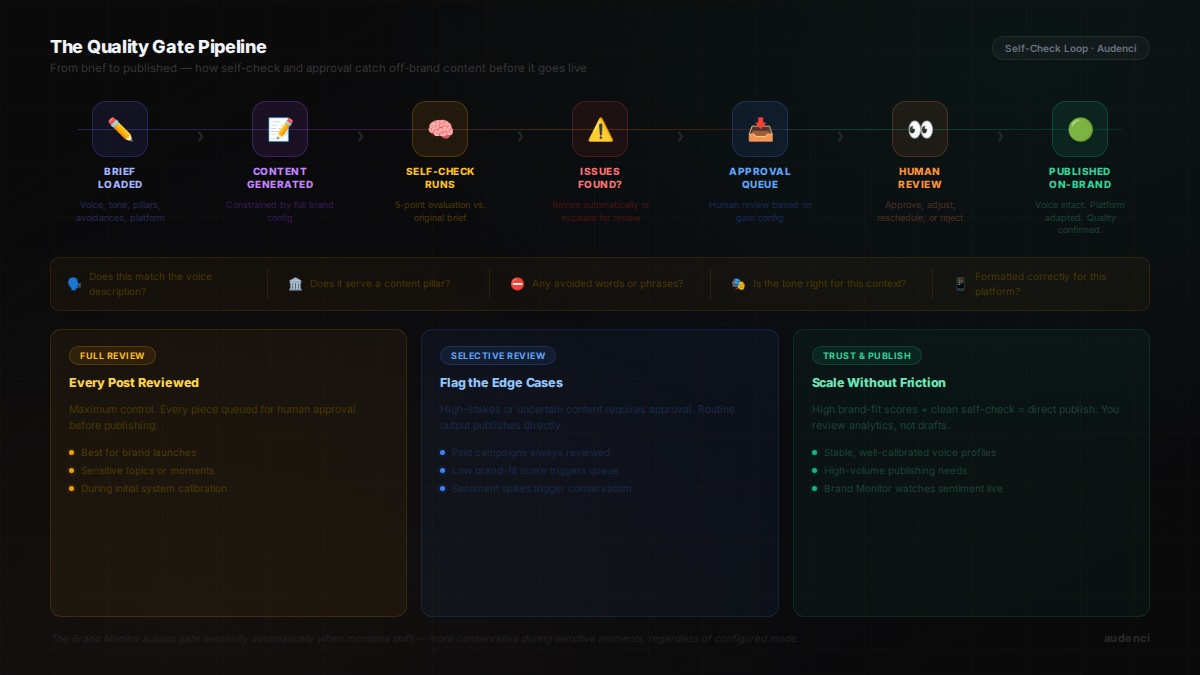
After every task is completed, each specialist runs a self-check. Not a simple grammar pass — a structured evaluation against the brief it started with.
"Did I follow the voice description?"
"Does this serve one of the defined content pillars?"
"Did I accidentally use any of the vocabulary on the avoidance list?"
"Is this appropriate for the platform this is going to?"
"Does this hit the right tone for this type of content?"
If any of those evaluations surface a problem, the content gets revised. The self-check runs before anything leaves the specialist's hands.
This is the loop that catches the drift that happens at scale. The subtle things: a slightly wrong register, a word that doesn't quite fit the brand's vocabulary, a post that's technically correct but doesn't feel like the brand.
Human editors catch these things when they read carefully. The self-check loop catches them when there's no human in the loop — which, at 50 posts per week, is most of the time.
Remix Without Copying: How Adaptation Preserves Originality
One of the highest-leverage content strategies is finding what's already working and making it yours.
The Remix Artist is built for exactly this. It monitors high-performing content across platforms, evaluates each piece for brand fit (does this align with our pillars, our audience, our voice?), and then decides how closely to adapt it.
There are three levels:
Close adaptation. The structure, hook, and format are directly inspired. The content and context are entirely the brand's own.
Modified adaptation. Takes the general concept or angle, applies it to a different subject, with significant original material.
Loose inspiration. The original piece is just a spark — a framing device or emotional hook that the brand builds something completely new from.
The Remix Artist tracks its own history. It knows what it's already adapted this week, which hooks it's used recently, which formats have appeared in the queue. This prevents the creative recycling that makes brands look like they're just following trends instead of setting the tone.
Brand fit scoring happens before adaptation, not after. If a piece of viral content conflicts with the brand's positioning — wrong tone, wrong values, wrong audience — it doesn't get adapted regardless of how well it's performing elsewhere.
The Approval Queue: Quality Gate Before Publish
High volume doesn't mean unreviewed output.
The approval queue lets you control exactly how much human oversight sits between AI-generated content and live publishing. You can set it up three ways:
Full review. Every piece of content lands in a queue before publishing. You review, approve, adjust, or reject. Maximum control. Useful during brand launches, sensitive moments, or when you're still calibrating the system.
Selective review. High-stakes content — paid campaigns, anything touching sensitive topics, content that's flagging uncertain brand fit — requires approval. Routine content publishes automatically. Good for established brands where the system has learned the voice.
Trust and publish. Content that scores high on brand fit and passes the self-check publishes directly. You review analytics and any flagged items. Best for brands with stable voice profiles and high content volume needs.
The Brand Monitor runs alongside all of this. If brand mentions shift — a competitor controversy, a cultural moment, a negative sentiment spike — the queue gets more conservative automatically. The system reads the environment and adjusts what needs human eyes.
The approval queue isn't overhead. It's the quality gate that makes high volume sustainable. Without it, 50 posts per week becomes 50 unreviewed decisions per week. With it, it becomes a scalable, auditable, refineable process.
What This Looks Like in Practice
A content creator running three brand accounts.
Monday morning: The Strategist runs its first planning cycle. It reads performance data from the week before, checks what's trending in each brand's space, and sets the week's content priorities. Directives go out to the specialists.
The Content Creator for Brand A has a B2B voice: direct, technical, mildly contrarian. It queues 8 posts for the week: 3 Twitter threads, 2 LinkedIn posts, 2 carousels, 1 Reddit contribution. Every piece starts from the brand context brief. Every piece passes the self-check.
The Content Creator for Brand B has a D2C voice: warm, lifestyle-forward, community-focused. It queues 12 posts: stories, carousels, short-form captions. Completely different register. Same system.
The Remix Artist finds a viral thread about productivity software. Brand A has a content pillar about workflow efficiency — strong brand fit. It adapts the angle as a loose inspiration, building an original post that references the broader conversation without copying the structure.
By Wednesday, Brand A has 3 posts live, 5 in the approval queue. The content creator reviews them in 12 minutes. One gets a minor tweak. Four publish as-is. One gets flagged for rescheduling to avoid overlap with a competitor announcement.
That's 50 posts per week. Three different brands. One content creator. No voice drift.
Why This Is Different From "Just Using AI"
The failure mode of generic AI content tools is well-documented by now.
You paste in a prompt. You add your brand name. You get content that sounds like everyone else's AI-generated content — the same sentence structures, the same hedge words, the same optimistic corporate tone.
The reason isn't that the AI is bad. The reason is that there's no brand context in the loop. The AI defaults to what "marketing content" sounds like in aggregate. Which means it sounds like nothing in particular.
Audenci's architecture inverts this. Brand context isn't something you paste into a prompt. It's a structured configuration that runs before every task, as a constraint on every output, enforced by a self-check after every generation.
The result is content that sounds like the brand — not because the prompt said "write in our voice," but because the system won't produce output that doesn't meet the specification.
Volume and voice aren't in tension when the system is designed to hold both.
The Bottom Line
Fifty posts per week is doable. The problem was never volume — it was the assumption that volume and quality are in opposition.
They're not. They're in opposition when your quality control relies on human energy, which depletes. They're not in opposition when your quality control is a system, which doesn't.
The brand context system, per-platform settings, the self-check loop, the remix tracking, the approval queue — these aren't features bolted onto a content generator. They're the architecture that makes high-volume publishing sustainable without turning your brand into a generic content machine.
Audenci protects your voice while scaling your output. Not by posting less. By making sure every post — no matter how many run that week — starts and ends with who you are.
Audenci is an AI marketing platform with 14 autonomous specialists that read your brand context before every task. Your voice at any volume.