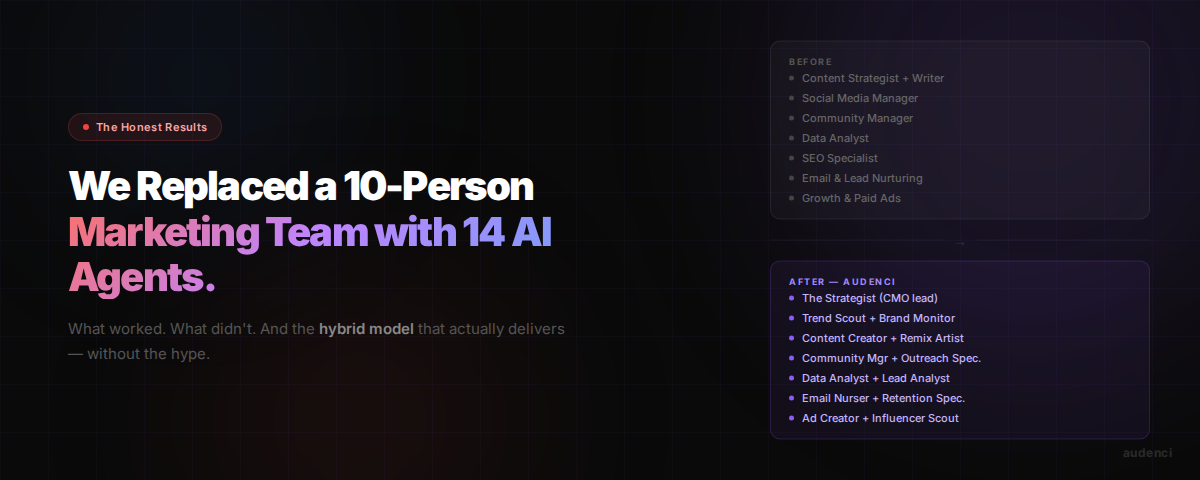
We Replaced a 10-Person Marketing Team with 14 AI Agents. Here's the Honest Truth.
 Thanh Hau Nguyen
Not hype — real results from replacing a 10-person marketing team with 14 AI agents. What worked, what didn't, and the hybrid model that actually works.
This is not a hype post.
When we set out to build Audenci, we made a bet: a coordinated team of AI specialists could handle the full scope of a modern marketing operation. Not just the easy parts. All of it.
Here's what actually happened — what worked better than we expected, what fell on its face, and what the hybrid model that actually works looks like in practice.
The Setup
Before AI, a full-stack marketing operation for a growing B2B company typically needs:
That's 9-10 roles. Most founders cover 2-3 and let the rest slide. Most early-stage companies hire 3-4 generalists and burn them out.
We replaced that with 14 AI specialists, organized exactly like a real department. Not a chatbot. A team.
At the top: The Strategist — the CMO. It sees everything, sets direction, delegates work. One critical constraint: it cannot create anything itself. It can only direct the team.
Below it: 14 specialists across Intelligence, Content, Engagement, Conversion, and Growth. Every specialist is autonomous. Every specialist has its own memory. And every specialist's work connects in a traceable chain from trend discovery to revenue.
Here's what we learned.
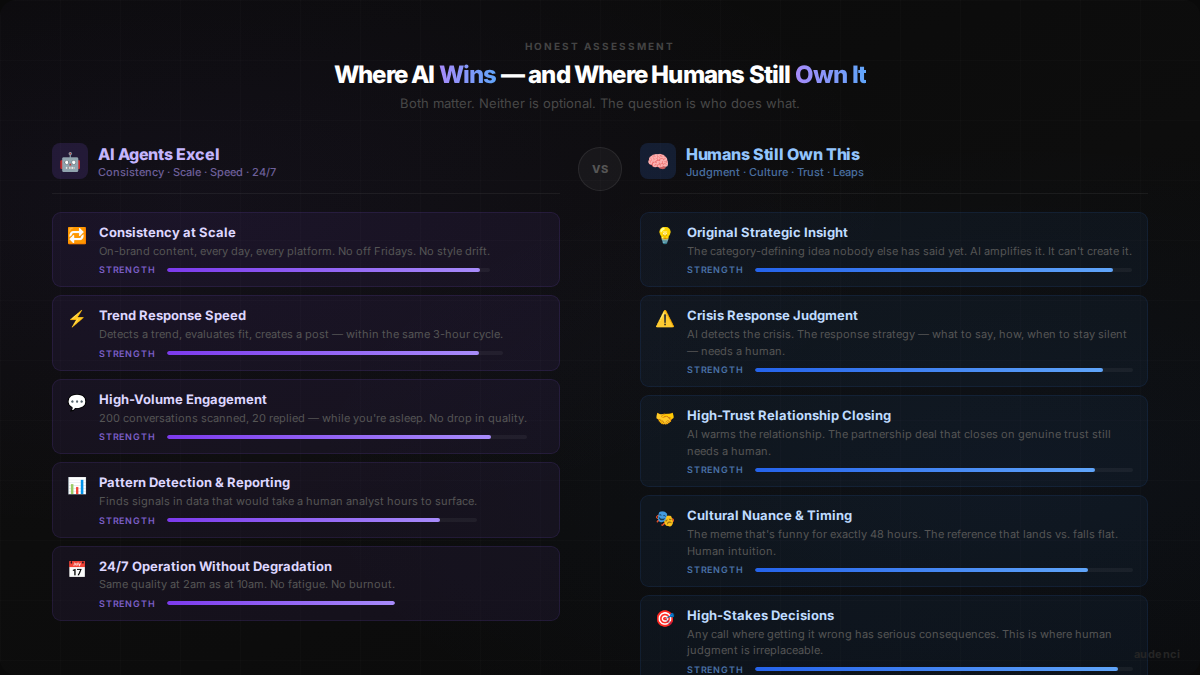
Where AI Beat Our Expectations
Consistency
This is where AI shines hardest — and most human teams fail quietly.
The Content Creator never has an off day. It doesn't get distracted, produce inconsistent quality on a Friday afternoon, or accidentally stray from brand voice because it's tired. It reads brand guidelines before every task. It checks what's working in recent performance data before deciding what to write. Every piece reflects the same voice, the same tone, the same style.
After running this for months, we realized that consistency — not genius — is what actually builds an audience. You don't need a viral post every week. You need reliable, on-brand content showing up every single day.
Human teams find consistency hard. AI finds consistency easy.
Speed
The Trend Scout can evaluate a new trend, check brand fit, assess virality potential, and classify its lifespan before a human marketer has opened their second tab.
When something breaks — a new tool launches, a relevant conversation explodes on Twitter — the Trend Scout flags it and The Strategist dispatches The Content Creator within the same cycle. That day, you have a post live. A human team might get there in two days, if you're lucky.
The Remix Artist works the same way. It surfaces viral content, evaluates how well it fits your brand, decides on the adaptation angle, and produces the reimagined version. The whole loop runs faster than a morning briefing meeting would.
24/7 Operation With No Degradation
At 2am, The Community Manager is still scanning conversations. The Brand Monitor is still watching for sentiment spikes. The Email Nurser is still sending emails at the optimal time for each lead's timezone.
This doesn't sound revolutionary until you see what it costs to stop. An engagement comment that arrives 3 hours late in a fast-moving thread is worth nothing. A win-back email that arrives in the morning instead of 2am is still fine. But being unavailable at 2am because your team is asleep? That's a gap.
We ran the comparison. AI agents running five daily cycles — from Morning Strategy through Night Reflection — covered time windows that a 10-person team working normal hours would never reach.
Volume at a Fixed Marginal Cost
The Outreach Specialist can send 50 personalized DMs in the time a human rep would research and write 5. The Community Manager can scan and evaluate 200 conversations per cycle and reply to the 20 that actually matter.
The cost doesn't scale with volume. Once the system is running, doing 3x more work doesn't cost 3x more money. That asymmetry is real and significant.
Where AI Struggled (Be Honest With Yourself)
Creative Leaps and True Originality
Here's the thing about The Content Creator: it's excellent at consistent, on-brand content. It's not excellent at "this category-defining idea that nobody has said before."
It can take a trending format and produce a great execution of that format. It cannot invent the format. It can write a strong post about a topic your audience cares about. It cannot have the original insight that nobody else in your market has had yet.
The best content that broke through — the posts that actually went viral, the piece that got 50 unsolicited reposts — came from a human handing the team a sharp original insight and saying "build around this."
AI amplifies original thinking. It doesn't replace it.
Crisis Judgment
The Brand Monitor is excellent at detecting a crisis early. Negative sentiment spike? It flags it immediately, classifies severity, and escalates.
But what to do about the crisis? That's harder.
We've seen the system produce technically correct responses to customer complaints that were tone-deaf to the actual emotional stakes. We've seen it recommend engagement with threads that a human would recognize as traps. A PR crisis is not a pattern-matching problem. It's a judgment call about people, context, and stakes — and that judgment, in high-pressure moments, still needs a human in the loop.
The monitor is reliable. The response strategy in a real crisis needs oversight.
Earned Trust and Genuine Relationships
The Outreach Specialist can write a personalized DM that references someone's recent post and sounds authentic. It follows a natural progression: warm intro, value first, gentle CTA.
But people are sharp. The relationship that closes a meaningful partnership deal — where someone says "I trust you personally and I want to work with you" — that doesn't happen through automated outreach alone. It happens through sustained, genuinely human interaction over time.
AI handles the top of the relationship funnel extremely well. The bottom still needs a real person to close it.
Reactive Cultural Moments
When a meme format explodes with cultural specificity — when something is funny because of a very particular shared understanding right now — AI often misses the nuance.
It's not bad at memes. It's bad at the tiny window where a cultural reference is funny instead of cringe. That window requires a human who lives in the culture, not one who models it.
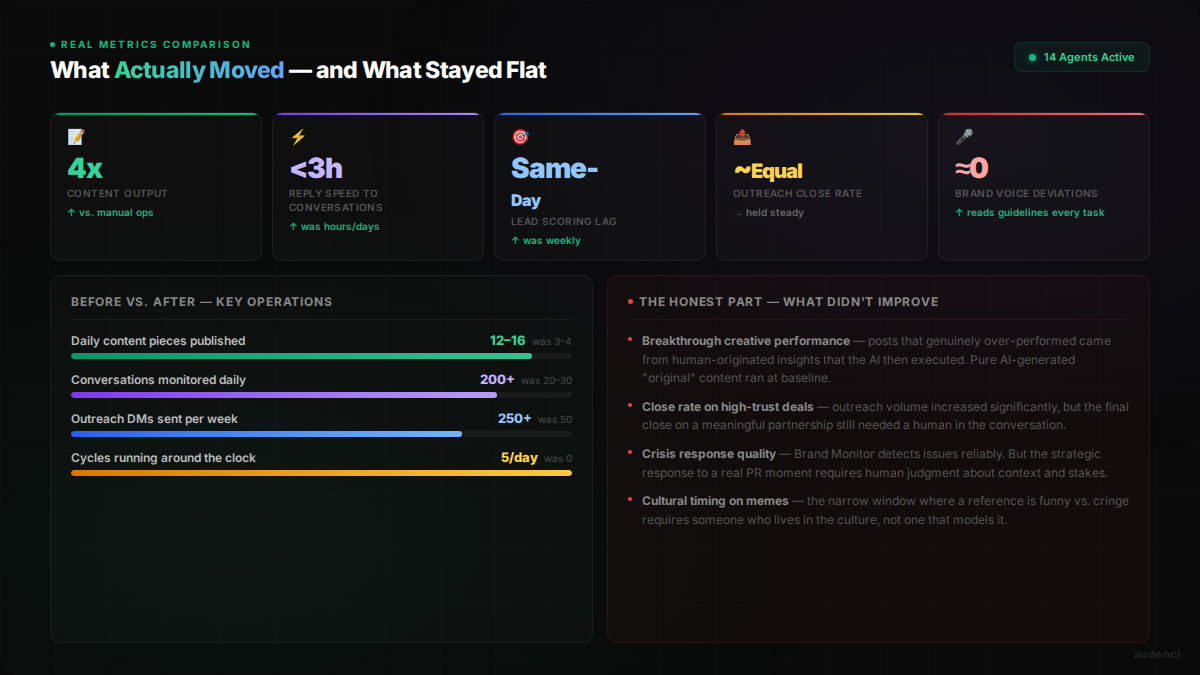
Real Metrics: What Actually Moved
Let's be concrete. Here's what changed when the system ran at full capacity versus the previous manual-plus-tools setup.
Content output volume: 3-4x increase. Not because we wanted more posts — because the team could now cover every platform, every day, without dropping any.
Reply speed to relevant conversations: From hours to under a cycle (under 3 hours during daytime windows). Conversations move fast. Getting in early matters.
Lead scoring lag: From "reviewed weekly" to "scored same-day." When The Lead Analyst runs every cycle, leads don't sit cold for a week waiting for someone to look at them.
Brand voice consistency: Near-perfect. The Content Creator reads brand guidelines before every task. No more "who approved this post?" moments.
Conversion from outreach: Similar close rate, much higher volume. The Outreach Specialist sends more personalized DMs than a human rep could physically write. The close rate stayed flat; the pipeline size increased.
One thing that didn't improve: Breakthrough creative performance. The posts that genuinely over-performed came from human-originated insights that the AI executed. Pure AI-generated "original" content performed in line with baseline — good, not exceptional.
The Hybrid Model That Actually Works
Here's the honest picture after building and running this:
AI owns everything that requires consistency, speed, scale, and 24/7 availability. That's most of marketing operations. The Strategist sets direction. The specialists execute it. The whole loop runs without human intervention on the routine cycles.
Humans own everything that requires genuine creative leaps, cultural intuition, crisis judgment, and closing high-trust relationships. That's a smaller slice — but it's the highest-leverage slice.
The practical division looks like this:
Leave it to the AI:
Keep humans in the loop:
The mistake most teams make is trying to replace human judgment entirely — or, the opposite mistake, using AI only as a drafting tool without giving it real autonomy. Neither works.
The sweet spot: give the AI team full autonomy over the repeatable, high-volume work. Keep humans focused on the things that genuinely require human judgment.
What Still Surprises Us
The memory system compounds over time in ways we didn't predict.
Each specialist has a capped memory — up to 50 learnings, decaying naturally so stale knowledge fades. What we didn't expect: the specialists actually get meaningfully better over weeks, not just marginally better. The Community Manager has refined which conversation types convert. The Content Creator knows which hooks land for this specific audience. The Data Analyst has built a model of what performance patterns mean.
This isn't an AI that plateaus at launch. It's one that builds institutional knowledge — just like a good employee does.
The Strategist's constraint is what makes it work.
We built The Strategist to be unable to create anything. It can only direct. Early testers always ask: "Why would you limit it?"
Because without that constraint, The Strategist would start writing mediocre captions instead of delegating to The Content Creator. It would try to handle everything itself and fail at all of it. The forced delegation is what makes each specialist bring their full capabilities to each task.
The best managers are the ones who genuinely delegate. The Strategist doesn't have a choice.
Attribution tracking is worth more than any single metric.
Knowing that a specific trend discovery led to a specific post that led to specific engagement that led to a specific lead — that chain is what turns a marketing automation system into an optimization engine. Without it, you're flying blind. With it, you can see exactly what's working and double down.
The Real Test: Would We Go Back?
No.
Not because AI is flawless — it isn't. But because the alternative isn't "10 great people handling all of this perfectly." The alternative is "3 people handling some of this, letting the rest slide, burning out in six months."
A well-coordinated AI team doesn't replace great people. It replaces the parts of a marketing operation that were either underfunded, skipped entirely, or handled inconsistently because humans have finite time and energy.
If you have a team of strong marketers, Audenci makes them dramatically more effective. If you don't have a full team yet, it fills the gaps without compromising on the work quality across the board.
That's the honest truth.
This Is What Audenci Does
Audenci is the AI marketing platform that runs this system for your brand.
14 autonomous specialists, coordinated by The Strategist, running five daily cycles across your social accounts, leads, and content pipeline. Each specialist builds memory over time. Every action traces back to outcomes.
You stay focused on the work that needs you. The team handles everything else.
[→ Learn more at audenci.com]