Stop Posting and Praying: From Guessing to Knowing What Works in Marketing
 Thanh Hau Nguyen
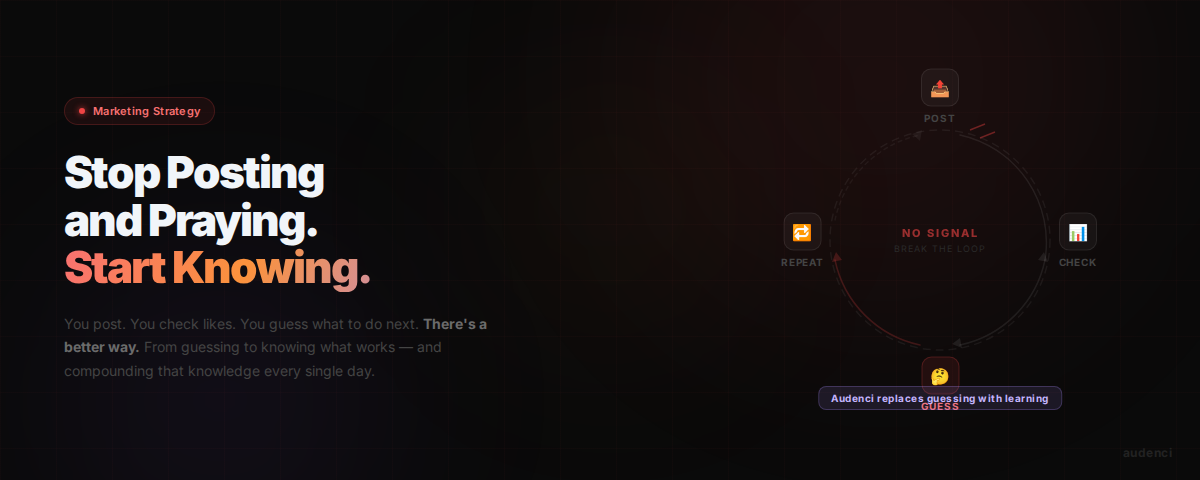
You post. You check likes. You guess what to do next. There's a better way. How a data-driven AI team replaces guessing with learning.
You post.
You check likes.
You guess what to do next.
That cycle — post, check, guess, repeat — is the default state of marketing for most businesses. And it feels productive. You're doing things. You're shipping content. You're watching the numbers. You're staying active.
But when someone asks, "What's actually working?" the honest answer is usually: "We think the video content does better... maybe. We're not totally sure."
That's not a strategy. That's a prayer.
The Post-and-Pray Cycle
Here's how most marketers operate, even smart ones running sophisticated businesses:
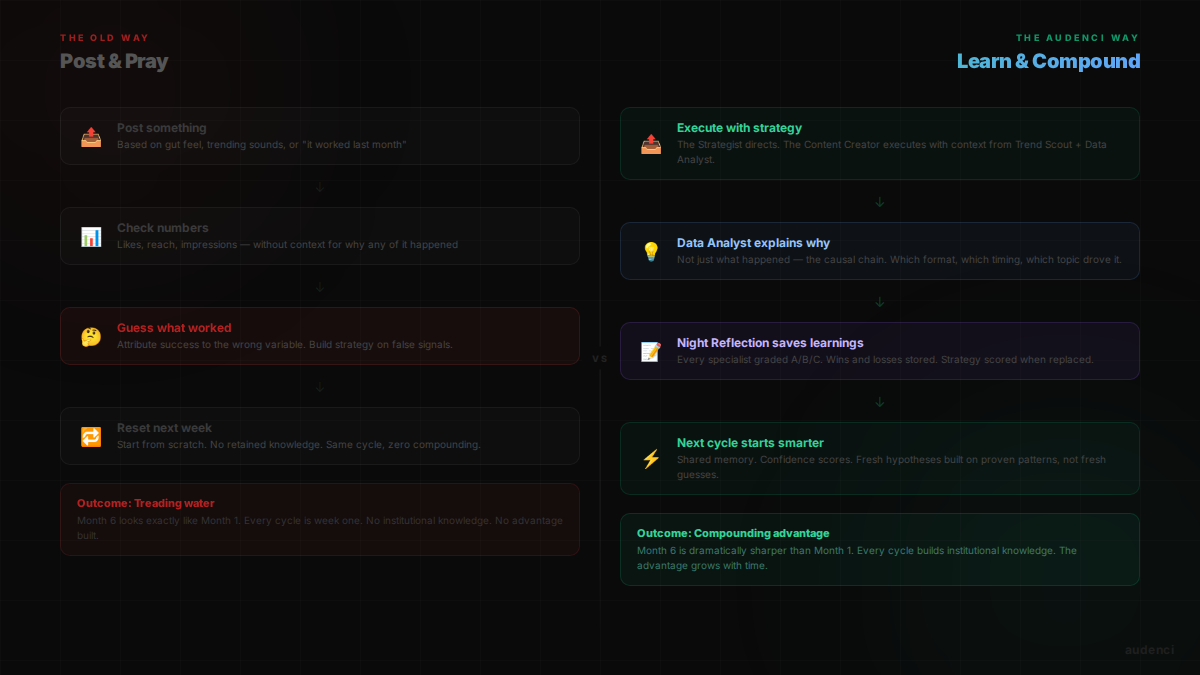
Monday: Brainstorm content ideas. Post a few things. Hope something connects.
Wednesday: Check analytics. Engagement is up. Assume it was the meme. Maybe it was the timing? Hard to say.
Friday: Try to replicate whatever seemed to work. It doesn't work as well. Shrug.
Next Monday: Start over from scratch with a slightly different guess.
This isn't a workflow problem. It's an information problem.
The data is there. The engagement numbers, the reach curves, the follow-through rates — all of it is sitting in dashboards waiting to be read. But data sitting in a dashboard doesn't tell you why something worked. It doesn't connect the dots between the trend your Trend Scout noticed on Tuesday and the spike in conversions your post triggered on Thursday. It doesn't explain that your carousel posts outperform single images by 3.4x, but only on Tuesday mornings, but only when they tap into topics your audience discovered in the previous 72 hours.
A human checking analytics every few days doesn't catch that pattern. By the time you notice it, the window has closed.
Why Intuition Fails at Scale
Your gut is not a bad tool. For small operations, early-stage businesses, or one-person teams, intuition shaped by experience is genuinely valuable. You know your audience. You've been in the room. You recognize the tone that lands.
But intuition breaks down at scale — and scale doesn't mean "millions of followers." Scale means posting consistently, running multiple channels, trying to grow, and needing to make decisions faster than a human reviewing spreadsheets can support.
Here's what happens when you rely on intuition at scale:
You remember the wins and forget the losses. The post that went viral lives in your memory. The thirty that didn't blend into background noise. Your intuition is trained on a skewed sample set.
You confuse correlation with causation. The post that worked came out on a Tuesday. So now Tuesday is "your best day." But it worked because of a trending topic, not the day of the week. You've now built a posting schedule around a false assumption.
You can't hold enough variables simultaneously. Format, timing, topic, hook style, caption length, hashtag strategy, audience segment — the number of interacting variables exceeds what any human can track without systematic help.
You don't know what you don't know. The pattern you're missing might be completely invisible to you — not because you're not smart, but because you haven't had the time or tool to surface it.
The post-and-pray marketer isn't failing because they're bad at marketing. They're failing because they're operating without a learning system.
A Team That Learns Instead of Guesses
The shift from guessing to knowing doesn't require more effort. It requires a different architecture.
Audenci runs a team of 14 autonomous AI specialists — not tools you have to prompt, but agents with clear roles who operate on a five-cycle daily system and share what they learn with each other.
The critical difference is the feedback loop. Every action generates information. Every piece of information feeds into the next decision. The team doesn't just execute — it builds institutional knowledge.
The Trend Scout doesn't just surface trending topics. It passes them to the Content Creator with context about why they're relevant to your audience and when the relevance window closes. That information gets logged. When a trend-connected post outperforms, that fact gets remembered.
The Data Analyst is the specialist that changes everything. Most analytics tools report numbers. The Data Analyst explains causality. It doesn't say "your engagement was 5.2% this week." It says: "Carousel posts drove the spike. Tuesday mornings outperformed every other window. A topic the Trend Scout flagged two days earlier appears to be the underlying driver. Here's what that suggests about the next cycle."
The Brand Monitor tracks what your competitors and your market are doing — and flags anomalies. When something shifts in the landscape, it doesn't sit in a report you'll get to eventually. It feeds directly into the strategy review.
Every day ends with a Night Reflection: each specialist gets graded A, B, or C on their work. Learnings are saved. What worked, what didn't, what should be tried differently. The next day starts with that context already loaded.
You don't have to carry the institutional knowledge in your head. The system carries it.
The Strategy Scoring System
Here's the piece most marketing systems miss entirely: learning from your own strategic decisions over time.
When the Strategist — the CMO-level AI that directs the team but never creates the work — decides to change direction, something specific happens. The old strategy doesn't just get shelved. It gets scored.
Was the previous strategy effective? Did it drive the outcomes it was designed to drive? What were its strengths and blind spots?
That score gets stored. It becomes part of a growing track record: a library of strategies that worked, strategies that didn't, and the specific conditions under which each performed.
Over time, this builds something remarkable: institutional marketing knowledge that accumulates instead of evaporating when you change direction.
Most businesses lose this. A campaign ends. A strategy gets replaced. The lessons from it live in someone's head, or in a document no one will read again, or nowhere at all. Six months later, the same strategic mistake gets repeated because no one remembered the last time it failed.
The Strategist's scoring system is a memory of decisions. Not just outcomes — decisions. Why was the strategy changed? What did the replacement strategy aim to fix? How did it measure up against its predecessor?
This is how you get smarter at the level of strategy, not just tactics. Tactics can be measured in days. Strategy plays out over months. Most teams never connect those dots. A system that scores and remembers does.
Patterns a Human Would Never Catch
When a learning system runs continuously over weeks, it starts surfacing insights that manual analysis would never find. Not because the data wasn't there — but because the pattern only becomes visible when you're watching everything, all the time, with no cognitive fatigue.
A few examples of the kind of patterns Audenci's specialists have surfaced:
The 48-hour trend window. Topics trending in a niche typically have a two-day window before saturation. Posts that go live within the first 24 hours of a trend outperform posts that respond 72 hours later by a wide margin. The Trend Scout, Data Analyst, and Content Creator coordination discovers this and starts pre-positioning content for trends before they peak — not after.
The carousel-Tuesday connection. Carousel posts drive 3x the saves of single images across most audiences. But that gap widens dramatically on Tuesday mornings and narrows on Fridays. A human reviewing weekly averages sees "carousels perform better." The Data Analyst sees "carousels perform 3.4x better specifically on Tuesday mornings, which appears to correlate with the professional content consumption pattern in your audience." Different insight. Different action.
The hook decay pattern. Certain opening lines that worked brilliantly in month one stop working in month three — not because the content changed, but because the audience has developed familiarity with the formula. The Remix Artist and Content Creator together begin tracking hook performance over time and rotating frameworks before they decay, rather than running them until they're dead.
The attribution chain. The Lead Analyst connects engagement to pipeline. It finds that a specific type of educational post (not the promotional posts, not the viral content) is the entry point for 60% of the audience members who eventually converted. That insight changes the Content Creator's priorities — not because someone decided it should, but because the attribution data made it undeniable.
These patterns were always there, in the data. The difference is having a team that's watching all the time and is built to surface them.
The Compound Advantage
There's a concept in finance called compound interest: the returns from previous periods generate returns in subsequent periods. Small advantages accumulate and accelerate.
Marketing has the same dynamic, but most teams never access it — because they're resetting to zero with each campaign, each hire, each strategy pivot.
A learning system that retains what it discovers doesn't reset. It compounds.
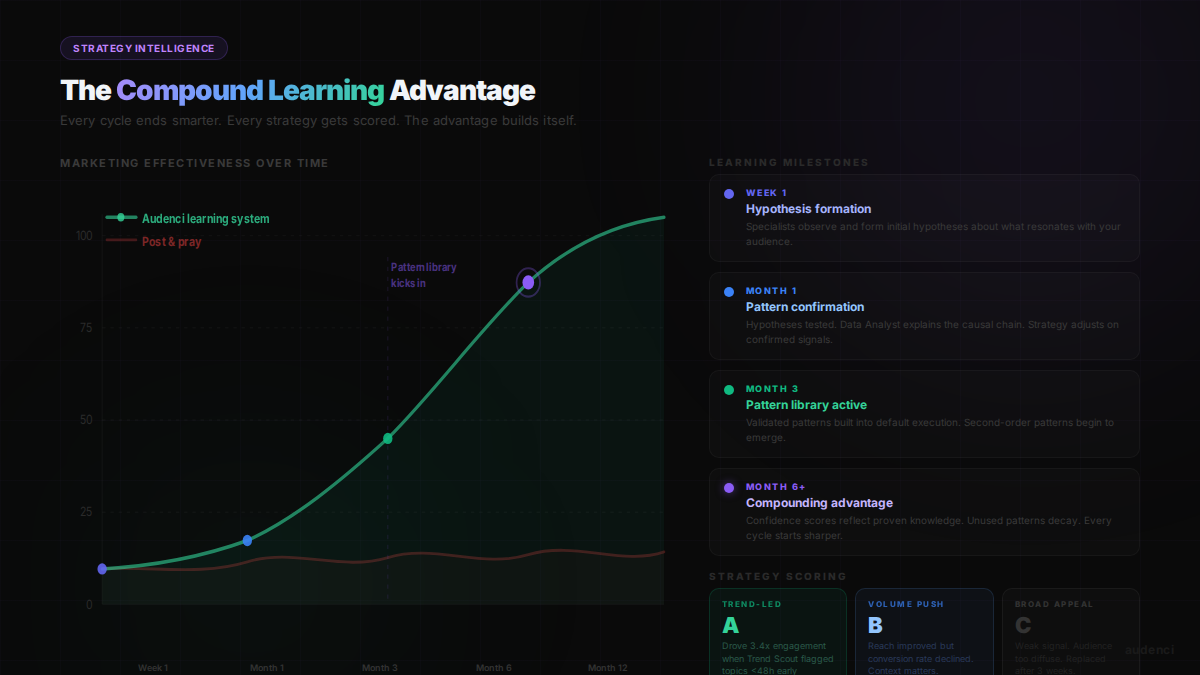
Week 1: The team learns which topics resonate. It forms hypotheses.
Month 1: The hypotheses get tested. Some are confirmed. Strategy adjusts.
Month 3: Confirmed patterns are built into default execution. The team is now operating on a foundation of validated knowledge, not fresh guesses.
Month 6: Patterns that took three months to surface are now standard operating procedure. The team has moved up to second-order patterns — not just what works, but what conditions make it work better.
Month 12: The accumulated knowledge makes every decision faster and better-calibrated. The confidence scores on specialist memories reflect what has been proven over time. Unused strategies decay so the system stays focused. The knowledge base is actively managed, not just accumulated.
Meanwhile, the post-and-pray competitor is still on week one every week.
This is not a marginal advantage. Over time, it's the difference between a marketing operation that compounds and one that treads water.
The compounding doesn't require you to get smarter. It requires a system that remembers for you.
What the Shift Actually Looks Like
You're not signing up for more complexity. The shift from guessing to knowing looks like this:
The Strategist reviews what the specialists learned and sets direction. Specialists execute with that direction. The Data Analyst explains why results are what they are. Night Reflection saves the learnings. The next cycle starts sharper.
You're no longer asking "what should we post today?" You're looking at a system that's already answered that question, with reasoning attached, based on what it learned yesterday and the day before.
You're no longer asking "why did that work?" You're reading the Data Analyst's explanation of the causal chain that led to the outcome.
You're no longer starting every quarter with a blank page. You're starting with a scored record of what previous strategies achieved, what this one needs to improve on, and why the current direction was chosen.
The decisions are still yours. The Strategist can be overridden. The direction can be adjusted. But you're working with knowledge, not faith.
The Only Question Left
If you've been marketing with guesses — and almost everyone has — the honest question to ask yourself is: what are you learning?
Not what you're doing. What you're learning.
Because the work you're putting out today should be making the work next month better. If it isn't — if each week is essentially starting fresh from intuition — then you're not building a marketing operation. You're running an activity that looks like marketing but isn't accumulating anything.
Audenci replaces guessing with learning.
Not by doing more work. By having a team that remembers what the work produces, scores what works, surfaces the patterns humans miss, and starts every day a little smarter than the last.
The prayer was always optional.
Audenci is an AI marketing platform with 14 autonomous specialists who don't just execute — they learn. Each cycle ends with a review. Each review makes the next one better. The post-and-pray era ends when the system starts remembering.