Why AI Keeps Getting Your Social Accounts Banned (And How to Fix It)
 Thanh Hau Nguyen
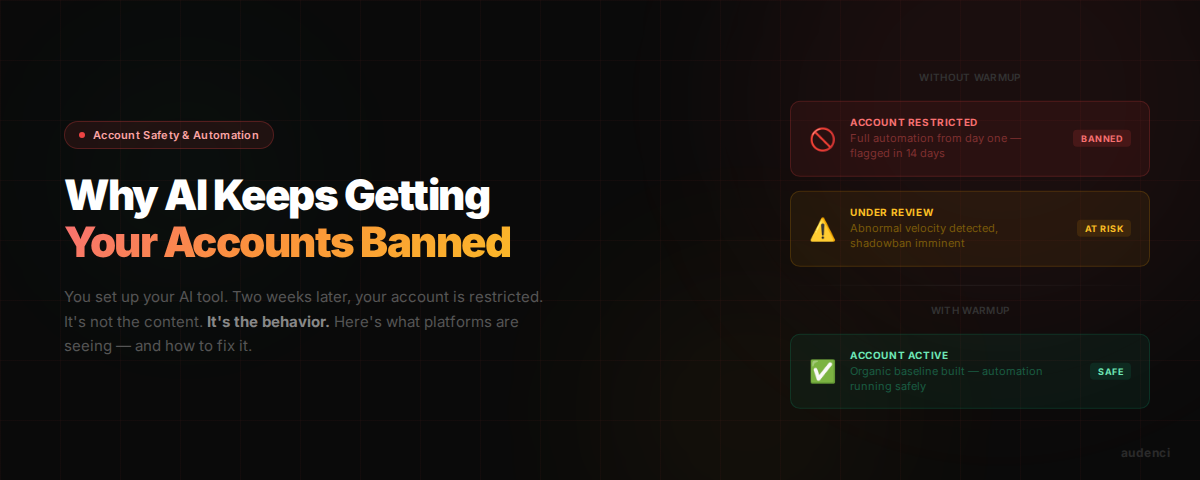
You set up your AI tool. Two weeks later, your account is restricted. Here's why platforms flag automated accounts and how to fix it.
You set up your AI tool. You connect your Twitter. You let it run.
Two weeks later, your account is restricted.
Sound familiar?
This keeps happening to smart, well-intentioned people. And the frustrating part: the AI was doing exactly what you told it to do. The problem isn't the content. The problem isn't your account. The problem is how the automation started.
Here's what platforms are seeing — and what you can do about it.
Platforms Are Not Stupid
Every major social network — Twitter, Instagram, TikTok, LinkedIn — runs behavioral analysis on every account. Not just content moderation. Behavioral pattern detection.
They're watching how you post. When you engage. How fast you move. How you compare to every other account on the platform.
Real users have irregular patterns. They post at weird hours sometimes. They miss a day. They like 3 things in a row, then nothing for an hour. They follow someone, unfollow someone, scroll aimlessly.
Automated accounts have suspiciously clean patterns. They post at consistent intervals. They engage at predictable rates. They never make the small, random "mistakes" of real human behavior.
The algorithm doesn't care whether your content is good. It cares whether your behavior looks human.
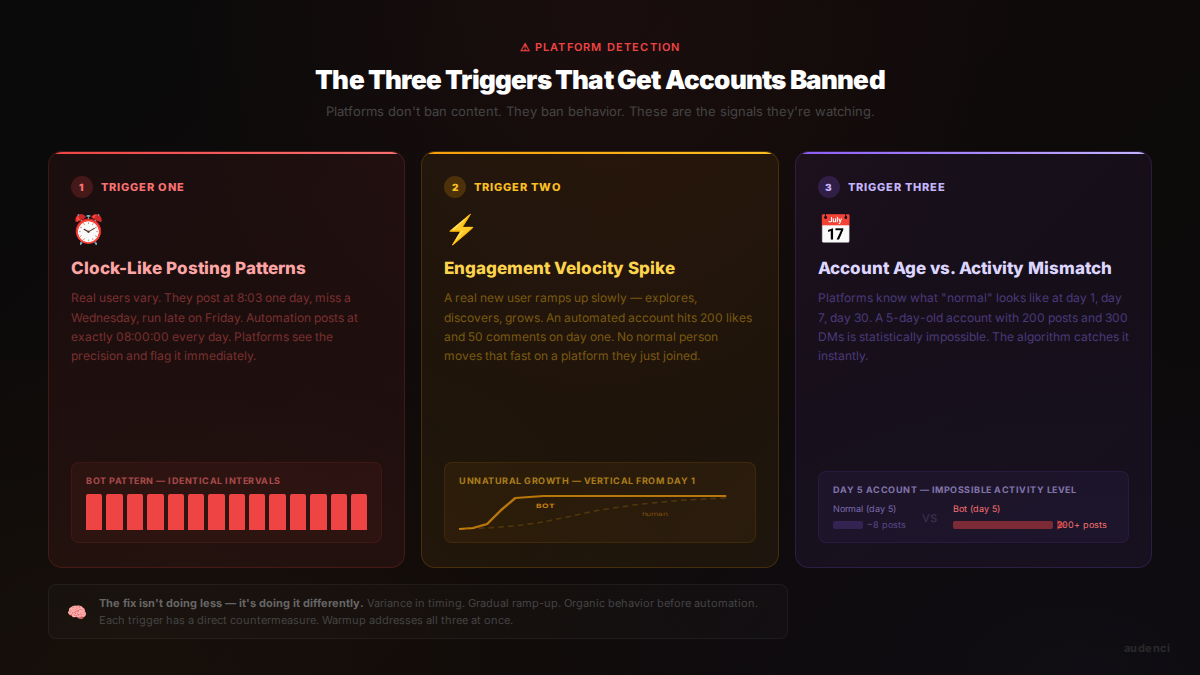
The Three Triggers That Get Accounts Banned
After losing multiple accounts ourselves and studying why, we identified three core behaviors that reliably trigger platform restrictions.
Trigger 1: Posting Patterns That Look Like a Clock
There's a difference between posting consistently and posting mechanically.
A real person who "posts every day at 8am" still varies slightly. 8:03 one day. 7:51 the next. They skip Saturday when something comes up. The pattern exists but it breathes.
An automation that posts every day at exactly 8:00:00 looks like a clock. Platforms see this immediately. The more precise your posting schedule, the more suspicious it looks.
The fix isn't to post less. It's to post with variance — small, intentional randomness in timing that mirrors how real people behave.
Trigger 2: Engagement Velocity That Spikes Out of Nowhere
New account. First week. Already liking 200 posts per day, commenting on 50, following 100 accounts.
No real user does this.
Real users ramp up naturally. They find the platform, explore it slowly, gradually discover more content and connections. Their engagement curve looks like slow growth over weeks, not a vertical line from day one.
When you deploy automation on a fresh account and let it run at full speed immediately, you're generating an engagement velocity that no normal person would produce. That's a flag.
Trigger 3: Account Age vs. Activity Mismatch
This is the one most people miss.
A five-day-old account with 200 posts, 500 comments, and 300 DMs is impossible. It cannot exist organically. Even the most active power user doesn't achieve that in their first week.
Platform algorithms have benchmarks. They know what "normal" activity looks like for an account that's 1 day old, 7 days old, 30 days old, 90 days old. When your numbers are 10x above those benchmarks on a brand new account, you're waving a flag.
Age matters. Reputation takes time. You can't shortcut it.
The Warmup Principle
Here's what experienced social media managers do instinctively — the thing most AI tools skip entirely.
They don't automate from day one.
When they set up a new account, they spend the first week or two just being a normal user. They scroll the feed. They like a few posts. They follow some relevant accounts. They watch content. They do nothing that looks strategic or automated.
Only after the account has established a behavioral baseline does the automation begin — and even then, it starts small.
This is called warmup. And it's not optional if you want to keep your accounts.
The logic is simple: platforms assign a trust score to every account based on its behavioral history. A new account with zero history has zero trust. Any unusual activity on a zero-trust account gets flagged immediately.
An account with two weeks of normal, organic behavior has a baseline. Now when automation starts, it looks like an escalation of existing human behavior — not a sudden robotic takeover.
Why Most AI Tools Skip This
Most AI marketing tools connect to social media through official APIs. That's fine for posting content, reading analytics, and tracking metrics.
But APIs can't scroll a feed. They can't watch a story. They can't browse through someone's profile the way a real person does.
So most tools just skip the organic behavior entirely. They jump straight to publishing and engagement. They have no mechanism for warmup — because you can't build a warmup phase using only an API.
This is precisely where accounts get lost.
The gap between "what the API lets you do" and "what a real person actually does on the platform" is exactly the gap that gets you banned.
Cloud Phones: Simulating Real Behavior
The solution we built starts with something you can't fake through an API: real device behavior.
Cloud phones are actual mobile devices running in the cloud. Not emulators. Not API calls pretending to be a phone. Real devices with real apps, real scrolling, real finger-movement simulation.
When a cloud phone runs a session, it looks exactly like a real person using their phone — because behaviorally, it is.
It scrolls the feed at a human pace. It pauses on content that would be interesting. It double-taps to like. It watches a story for the full duration. It follows an account and then keeps browsing. The timing between actions has the small irregular gaps that real people have.
Social platforms can detect device fingerprints, scroll patterns, tap timing, and session duration. Cloud phones pass all of those checks — because they're genuine device interactions, not API calls.
This is what makes warmup actually work.
The WARMING UP → ACTIVE System
Every new account in Audenci starts in a state we call WARMING UP.
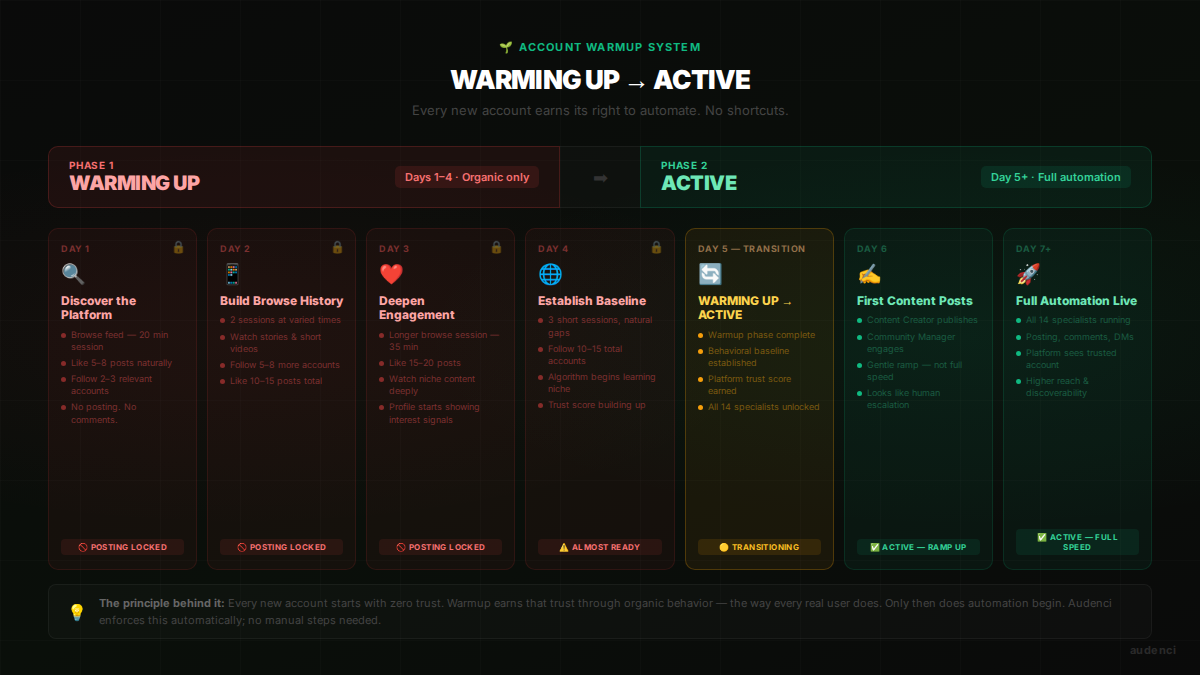
During warmup, the account has strict constraints:
Instead, the cloud phone runs 1 to 3 natural browsing sessions per day. The sessions happen at varied times — not always at 9am, not always for exactly 30 minutes. Real people use their phones at different times. The system mirrors that.
The account scrolls. It likes. It follows relevant accounts. It watches content. It behaves like a new user discovering the platform for the first time, because that's exactly what the algorithm should see.
After the warmup period is complete, the account transitions to ACTIVE.
Now the full system engages. The Content Creator starts publishing. The Community Manager starts engaging with replies. The Outreach Specialist begins personalized conversations. All of the 14 specialists that were waiting in the wings can now operate.
The difference: they're operating on an account that has a behavioral history. An account the platform trusts. An account that has earned the right to be more active.
Real Accounts: Lost vs. Saved
We learned this lesson the hard way.
Before we built the warmup system, we lost accounts. Multiple of them. Some were accounts we'd invested months building — followers, content history, engagement reputation. Gone in a single restriction wave because we connected automation too aggressively, too fast.
Looking back, the pattern was obvious. Every account we lost shared the same story: connected automation on day one, ramped up to full activity immediately, got flagged within two weeks.
After building the warmup system, the story changed.
Accounts that went through the warmup phase — even just a few days of organic browsing before any automation — survived. They didn't just survive. They built engagement velocity that looked normal because it was built on a foundation of normal behavior.
The accounts we saved weren't saved because the content was better. They were saved because the behavior was better. Because when the automation kicked in, it looked like a natural progression, not a sudden attack.
One specific case: a brand account we set up for a product launch. Under the old approach, we would have started posting on day one to maximize the launch window. Under the new approach, we ran 10 days of warmup first — the account browsed competitors, engaged organically with the niche, built a profile history. When the launch content went live, the algorithm treated it like an established account with relevant behavioral history. The reach was dramatically higher than anything we'd seen on a cold start.
The warmup cost 10 days. The reach improvement more than made up for it.
What This Means for You
If you're using any automation tool right now, ask yourself these questions:
Does it have a warmup phase? If it goes straight to posting and engaging on day one, you're at risk. Every day you run full automation on a new account without warmup is a day closer to a restriction.
Does it vary its timing? Robotic precision is a red flag. Your tool should be adding variance to posting times, engagement frequency, and session duration.
Does it simulate organic behavior? Can it scroll a feed, watch a story, browse without leaving a trace that screams "this is software"? If not, it's working with a behavioral gap the platform will eventually notice.
Does it respect account age? New accounts should do less — much less — than established ones. If your tool treats a 2-day-old account the same as a 6-month-old account, it's going to burn accounts.
The Right Way to Automate
There's a mental model that fixes everything: automation is not a shortcut to human behavior. It's a simulation of it.
Real people earn trust slowly. They build history. They show up consistently over time. They don't magically appear at full activity on day one.
If your automation doesn't mirror that arc — slow start, gradual ramp, earned trust — it's going to keep triggering platform defenses. Not because the platforms are catching up to AI. Because the platforms have always been watching behavior, and behavior that doesn't match the human arc has always looked suspicious.
Audenci warms up every account before activating automation. It's not a nice-to-have feature. It's the thing that makes everything else work.
The Strategist doesn't even dispatch the Community Manager or the Content Creator until the warmup phase is done. The 14 specialists are powerful — but their power depends on operating on an account the platform trusts. And that trust has to be built first.
The Bottom Line
The accounts that get banned aren't failing because the AI is too smart or too aggressive. They're failing because the automation skipped the boring part — the unglamorous first two weeks where nothing visible happens, but the account earns its right to exist.
Warmup isn't a workaround. It's respect for how platforms actually work.
The platforms know the difference between a new user and a bot. The gap is behavioral history. You either build it the right way — slowly, organically, before automation kicks in — or the platform builds a case against you.
Every account we've saved followed the same path: warmup first, automation second. Every account we've lost skipped the first step.
Don't skip the first step.
Audenci is an AI marketing platform that warms up every account before activating its 14 autonomous specialists — because accounts that skip warmup don't last long enough to benefit from automation.