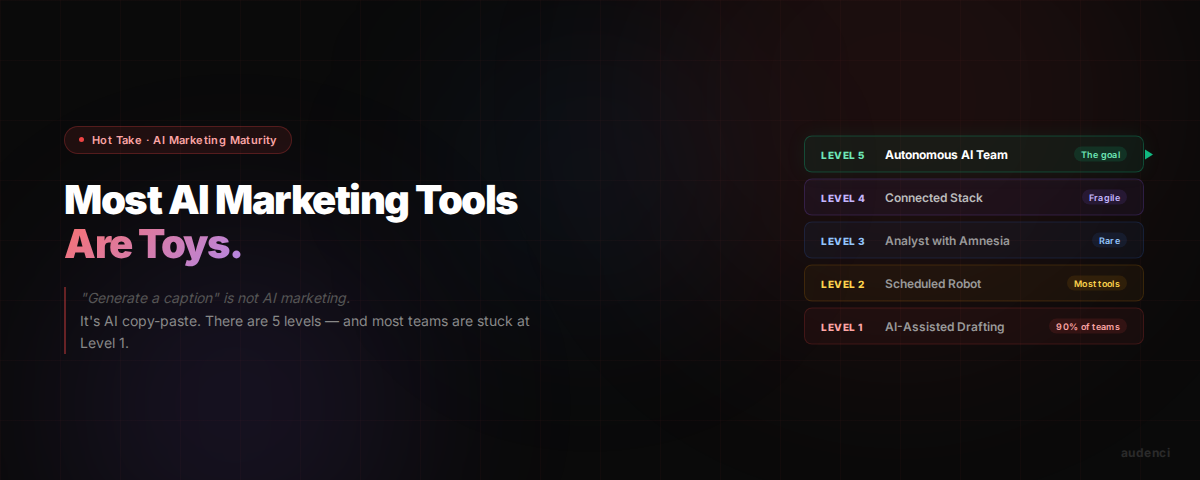
Why Most AI Marketing Tools Are Toys (And What a Real System Looks Like)
 Thanh Hau Nguyen
"Generate a caption" is not AI marketing. It's AI copy-paste. Here's the difference between a tool and a system — and why the industry is stuck at level 1.
"Generate a caption" is not AI marketing. It's AI copy-paste.
You open Jasper, type a brief, get a caption, copy it into Buffer, schedule it. You feel productive.
You did that three times this week.
And your marketing is exactly as good as it was before AI existed.
Here's the uncomfortable truth: most AI marketing tools are sophisticated autocomplete. They're fast. They're impressive at demos. And they do almost nothing that matters at scale.
The difference isn't the model. It's the architecture. It's whether you have a tool or a system.
Let me show you what I mean with a framework I've been thinking about for a while: the five levels of AI marketing maturity.
Level 1: The Copywriter's Calculator
This is where 90% of teams live.
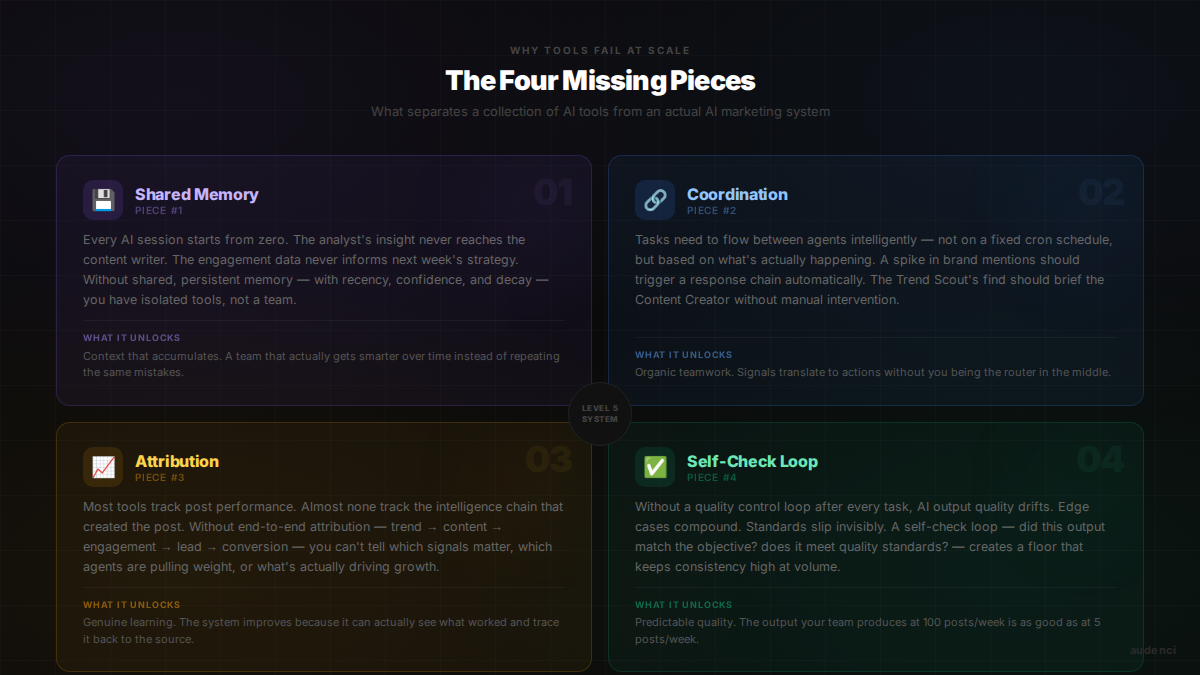
You have ChatGPT, Jasper, maybe Copy.ai. You type in a prompt. You get output. You edit it. You post it.
The AI did the typing. You did the thinking. You're still the system.
What's missing: Everything else. The AI has no idea what you posted yesterday. It doesn't know what worked. It can't see your competitors. It doesn't know the difference between Monday morning and Friday afternoon.
Every session starts from zero.
Level 1 tools are great for one thing: removing the blank page problem. That's genuinely useful. But it's not marketing. It's drafting.
Level 2: The Scheduled Robot
You graduate to tools that connect AI generation to scheduling. Hootsuite + AI. Buffer + AI generation. Lately. Predis.
Now your captions get auto-posted. Progress!
Except: the AI still doesn't know what's happening in your market right now. It doesn't know your last post bombed. It doesn't know your biggest competitor just announced something. It doesn't know your audience shifted.
You've automated the action. You haven't automated the thinking.
The pattern here is always the same: Level 2 tools take a single task and make it faster. They are excellent at the task. They are blind to everything around the task.
A tool that writes faster captions is still just a caption writer.
Level 3: The Analyst with Amnesia
Here's where it gets interesting — and frustrating.
You start using AI tools that can actually look at your analytics. They tell you "video posts perform 3x better on Thursdays." They generate reports. They identify patterns.
But then... nothing happens with that insight. It doesn't feed back into what gets created next week. The caption writer doesn't know what the analyst discovered. The scheduler doesn't know the analyst exists.
You have multiple AI tools. They don't talk to each other.
This is the broken promise of the "AI marketing stack." You've assembled a collection of smart, isolated tools — and they operate in total ignorance of each other.
The analyst has amnesia every morning.
The fundamental problem: no shared memory, no coordination, no learning loop.
Level 4: The Connected Stack (Rare, Expensive, Fragile)
A few sophisticated teams wire things together with Zapier, Make, or custom integrations. Analyst output feeds into a prompt template that feeds into the generator that feeds into the scheduler.
This is real progress. Insights actually flow. Actions actually connect.
But it's brittle. It's expensive to maintain. Every new channel breaks the plumbing. And it still lacks something critical: judgment.
The connections are mechanical. If trend → post, always. No nuance. No "should we actually post about this right now given our brand positioning?" No one is setting strategy across the whole system.
You have coordination without intelligence.
Level 5: The Actual Team
This is what AI marketing should look like.
Not a tool. Not a stack. A team — with roles, memory, strategy, and a communication protocol.
Here's what that means in practice (and what we built with Audenci):
Someone sets strategy and coordinates everyone else. We call ours The Strategist. Think of it as the CMO of the AI team. The Strategist sees everything: what's trending, what's working, what the brand needs this week, what the competitors are doing. It sets direction and delegates work.
Critically: The Strategist never creates anything itself. It only directs. This matters enormously. A manager who's also doing IC work is a bad manager. The Strategist's entire job is knowing the full picture and making good delegation decisions.
Specialists handle specific domains — and actually communicate. The Trend Scout is watching your market. The Brand Monitor tracks mentions and competitors. The Data Analyst is looking at what's working. The Content Creator turns briefs into actual posts — six formats, platform-specific.
When the Trend Scout spots something, that insight goes into shared memory. The Content Creator can see it. The Strategist factors it in. Nothing is siloed.
The memory system is the secret weapon. Every piece of intelligence has a confidence score and a freshness score. Old data decays. High-confidence insights get prioritized. There's a cap of 50 active memories — so the team is always working with the most relevant, recent picture of your market.
This is not like a database. It's more like how a good human team actually operates: recent context is top of mind, stale context fades, and the team builds a shared understanding over time.
Five daily cycles keep everything moving. Strategy in the morning. Creation during the day. Engagement in the afternoon. Review at end of day. Reflection overnight (where the team actually processes what worked and updates its understanding).
Not one big waterfall. Not random triggered tasks. A rhythm — like a real marketing department.
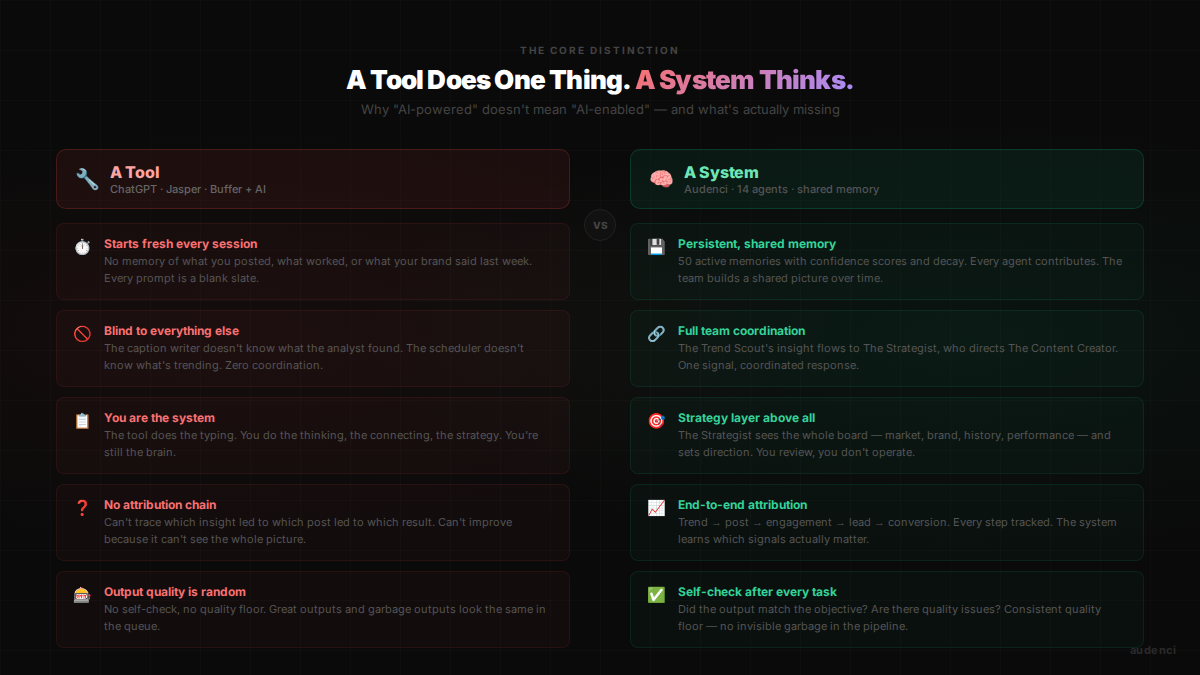
The Four Missing Pieces (Why Most Tools Never Get to Level 5)
When I think about why the industry is stuck at Level 1-2, it comes down to four things that almost nobody has built:
1. Shared Memory
Tools don't remember what other tools learned. Every AI session is a fresh start. Level 5 requires a persistent, shared knowledge base that all agents contribute to and pull from. Not just a database — a living memory with recency, confidence, and decay built in.
2. Coordination
Tasks need to flow between agents based on what's happening, not just on a fixed schedule. The Community Manager notices a spike in mentions → The Strategist decides if it needs a response → The Content Creator drafts one. That chain has to be automatic and intelligent.
3. Attribution
If a trend spotted on Monday leads to a post on Wednesday that generates a lead on Friday, you need to know that. The full chain: trend → content → engagement → lead → conversion. Most tools track post performance. Almost none track the intelligence chain that created the post.
Without attribution, the team can't learn. You can't know whether The Trend Scout is actually surfacing good signals or noise.
4. A Self-Check Loop
Every specialist in Audenci runs a self-check after completing work. Did the output actually match the objective? Are there quality issues? Should the Strategist be informed?
This sounds small. It's not. It's the difference between a system that produces consistent quality and a system that slowly drifts toward garbage as edge cases compound.
Without self-checking, AI output quality is unpredictable. With it, quality is bounded.
Why the Industry Is Stuck
Venture capital loves demos. Demos reward individual tasks that look impressive — "watch it write 50 posts in 2 minutes." Nobody demos "watch it build shared memory over 30 days and make better decisions as a result." That's not a demo. That's a product.
Tool companies are incentivized to keep you coming back to their interface, entering prompts, feeling the magic. A system that runs autonomously in the background — that's actually harder to charge for, harder to explain, and harder to sell to a VP in a 20-minute call.
So the market optimizes for Level 1 and 2. It's faster to build, easier to demo, and easier to explain.
The result: a market full of very fast copywriters and very slow thinkers.
What "Real" AI Marketing Actually Feels Like
When it's working — Level 5 working — the experience is disorienting in a good way.
You don't open the tool. The tool is running.
Monday morning: The Strategist has already processed overnight reflection, noticed that your last three posts in a particular format underperformed, and is adjusting the content mix for this week. The Trend Scout already spotted two emerging conversations in your space. The Brand Monitor already flagged a competitor announcement from the weekend.
You get a summary. You approve the direction. The team executes.
You're not in the tool. You're a stakeholder reviewing the team's work.
That's what AI marketing should feel like. Not "how do I prompt this to write a good caption." But "what did the team learn this week, and what are they doing about it."
The Levels, Summarized
| Level | What You Have | What's Missing |
|-------|--------------|----------------|
| 1 | AI-assisted drafting | Memory, context, continuity |
| 2 | Scheduled AI content | Awareness, feedback loops |
| 3 | AI analytics | Coordination, shared memory |
| 4 | Connected stack | Judgment, strategy layer |
| 5 | Autonomous AI team | (Nothing — this is the goal) |
Most tools give you Level 1 with a Level 2 wrapper and call it "AI-powered marketing."
It's not. It's autocomplete with a scheduler.
The Hard Truth About Where You Are
If you're currently spending time on:
You are at Level 1 or 2.
That's fine. It's where most people are. But you should know that's where you are, and you should understand what it would take to get to Level 5.
The answer isn't a better prompt. It's a different architecture.
What We're Building
Audenci is our attempt at Level 5.
14 specialists. One Strategist. Shared memory with decay and confidence scoring. Five daily cycles. Attribution from signal to conversion. Self-check loops after every task. Brand voice baked in, per platform.
We built it because we got frustrated at Level 2. We kept hitting the same wall: great individual outputs, no system intelligence. The insights weren't flowing. The agents weren't talking. The team wasn't actually a team.
So we built the coordination layer. Then the memory layer. Then the attribution layer. Then the self-check loop. Each one unlocked something the previous layer couldn't do.
I'm not saying it's finished. I'm saying it's the right architecture — and most of what's on the market today isn't even asking the right questions.
If you're building an AI marketing strategy and you're still at Level 1, the question isn't "which AI writing tool is best." The question is: when does your AI team actually start thinking for itself?
That's the question Level 5 answers.
Building Audenci in public. More on the architecture, the lessons, and the things that broke along the way.