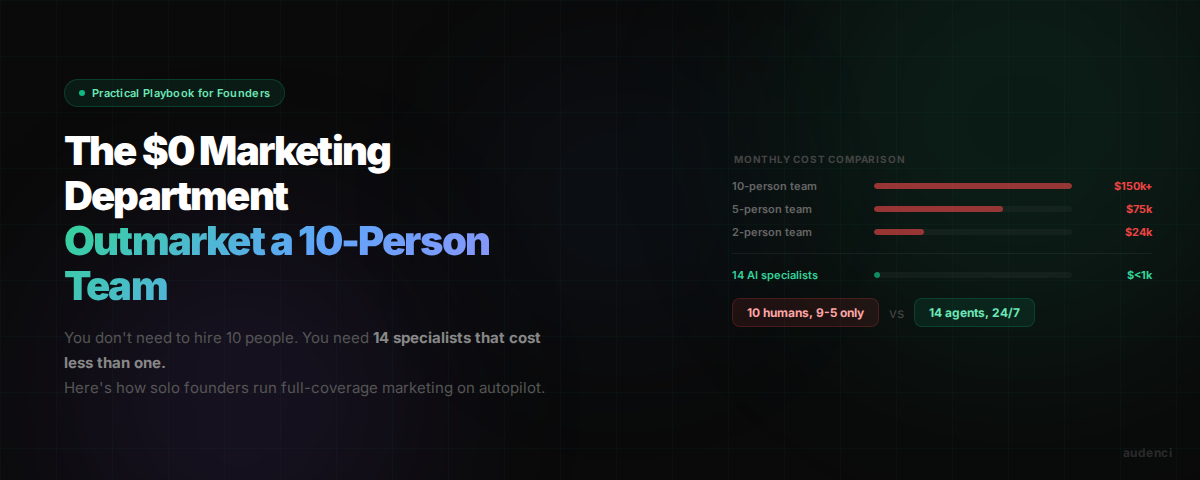
The $0 Marketing Department: How a Solo Founder Can Outmarket a 10-Person Team
 Thanh Hau Nguyen
You don't need to hire 10 people. You need 14 AI specialists that cost less than one. A practical playbook for solo founders.
You don't need to hire 10 people to do serious marketing.
You need 14 specialists that cost less than one.
That's not a pitch. It's the thing we figured out building Audenci — and once you see it, you can't unsee it.
The Real Disadvantage of Being Small
Every bootstrapped founder knows the math.
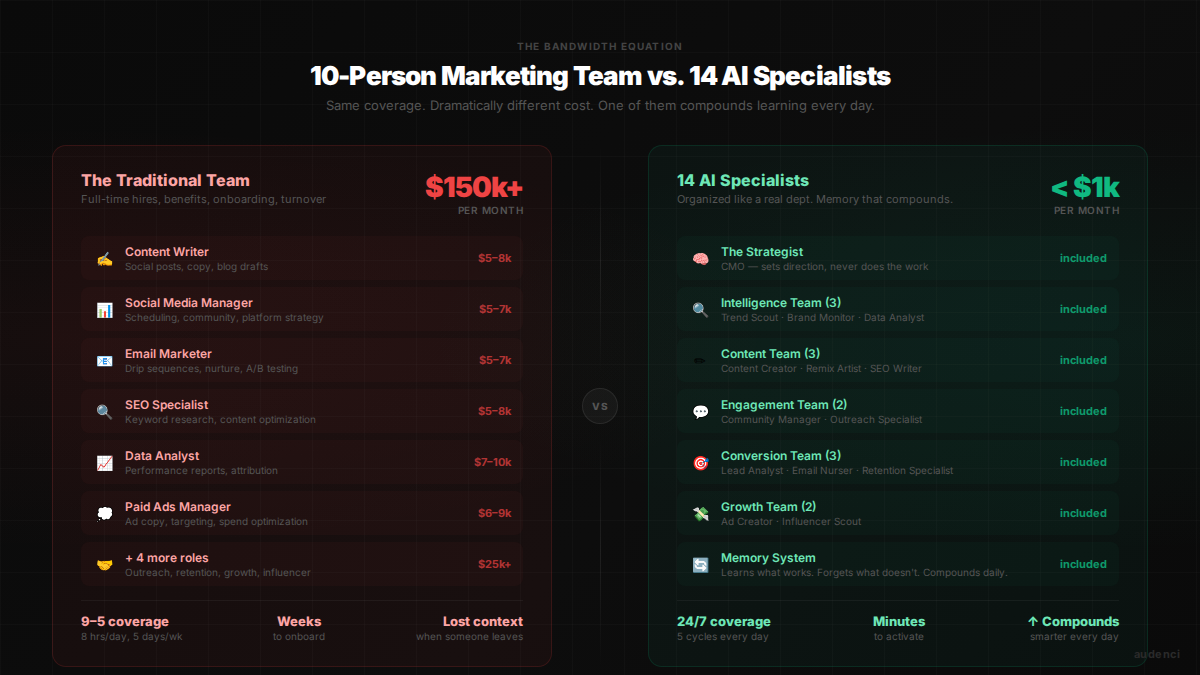
A funded competitor has a content writer, a social media manager, an email marketer, a community manager, an SEO person, a data analyst, a growth hacker, and a paid ads specialist. Maybe more. They're posting every day, replying to every mention, running A/B tests on email sequences, and tracking every click.
You're one person. You're also building the product, handling customer support, and trying to sleep occasionally.
So you do what every solo founder does: you pick 2 or 3 channels, do them inconsistently, and tell yourself you'll "figure out marketing later."
Here's what no one says out loud: the bottleneck isn't budget. It's bandwidth.
A 10-person marketing team doesn't have a better strategy than you. They just have more hands. More coverage. More execution happening simultaneously. You're not losing because they're smarter. You're losing because they can be in ten places at once and you can't.
That's a solvable problem.
The Insight That Changes Everything
Real marketing departments aren't run by one genius who does everything. They're organized into specialists coordinated by a team lead who sets direction and delegates.
The content writer doesn't need to understand lead scoring. The data analyst doesn't need to write ad copy. The community manager doesn't need to know the email nurture sequence. Each person owns their lane. The team lead sees the whole board.
When we built Audenci, we tried to make one AI do everything first. It was a disaster.
It got confused halfway through tasks. It mixed up tone for different platforms. When something broke, we had no idea who was responsible.
Then we asked the obvious question: why are we building a solo AI when every real team is built on specialists?
So we built a team. Not one AI — 14.
Meet Your New Marketing Department
Here's what 14 specialists running your marketing actually looks like.
The Strategist
This is your CMO. The team lead. The only one who sees everything.
The Strategist reads all the reports, spots the patterns, sets the priorities, and tells each specialist what to accomplish for the day. It dispatches work in the right order — intelligence first, then content based on that intelligence, then engagement, then conversion.
Here's the critical part: The Strategist cannot create anything. It cannot write a single caption, send a single DM, or produce a single piece of content. It can only direct the team.
That constraint is the whole design. Without it, you get one overwhelmed generalist. With it, you get a system where every task goes to the specialist best equipped to handle it.
Intelligence: Knowing What's Actually Happening
The Trend Scout doesn't just find trends — it evaluates them. For every trend it surfaces, it asks: Does this fit our brand voice? Does our audience care? Is this rising or falling? Can we say something original here? Is it already crowded? Some trends demand a post within 24 hours. Others are worth building a content series around. The Trend Scout knows the difference.
The Brand Monitor watches every corner of the internet for mentions of your brand. Sentiment shifts. Emerging complaints. Unexpected praise. The moment something looks like a crisis, it raises an alarm.
The Data Analyst doesn't report that engagement was 4.8% this week. It tells you that Tuesday mornings outperform everything else, that one carousel post nearly went viral because it rode a trend spotted 48 hours earlier, and that three of your last four high-engagement posts shared a specific format you should lean into.
Content: Building at Scale
The Content Creator handles six formats — image posts, carousels, reels, video, text-only, stories — tuned per platform. Your LinkedIn gets polished thought leadership. Your Twitter gets sharp, punchy takes. Your Instagram gets visual storytelling. Same brand, different voice, right format for each surface.
The Remix Artist finds viral content across the internet and asks: how does this concept work for our brand? Not copying. Remixing. It scores each piece of viral content for brand fit, decides how closely to adapt it, and tracks what's already been remixed so nothing repeats.
The SEO Writer handles the long game. Keyword research. Search intent analysis. Blog posts that feed organic discovery for months. It also passes keyword insights to the rest of the team so social content reinforces the same topics.
Engagement: Being Present at Scale
The Community Manager finds the conversations your audience is already having. On Twitter. On Reddit. On TikTok. On Instagram. It reads each thread and decides: is this worth engaging with? Only the best matches get a reply — and that reply is written to match the platform's culture, not copied across all of them.
The Outreach Specialist handles personalized DMs. Not blasts. Not copy-paste sequences. It researches who's most engaged, checks past conversation history, and starts each conversation warm — with value first, a gentle ask much later.
Conversion: Turning Attention into Revenue
The Lead Analyst scores leads on engagement velocity, channel reach, recency, and buying signals. It monitors whether your pipeline health is where it should be — enough cold leads, enough warm, enough hot — and flags imbalances before they become problems.
The Email Nurser runs drip sequences that adapt to how warm a lead is. Cold leads get education. Warm leads get case studies and social proof. Hot leads get direct offers. It finds the best send time per person based on historical open behavior.
The Retention Specialist watches for churn signals before customers leave. Decreasing interaction. Growing gaps between logins. Reduced spending. It segments by risk level and runs targeted win-back campaigns while there's still something to win back.
Growth: Finding Your Next 1,000 Users
The Ad Creator generates copy concepts, targeting suggestions, and multiple variations for testing. It learns from what's already working in organic content and applies those patterns to paid.
The Influencer Scout finds creators who actually match your niche and audience — not just by follower count but by engagement quality and audience alignment. It drafts the outreach message so The Outreach Specialist can send it.
The Daily Autopilot Cycle
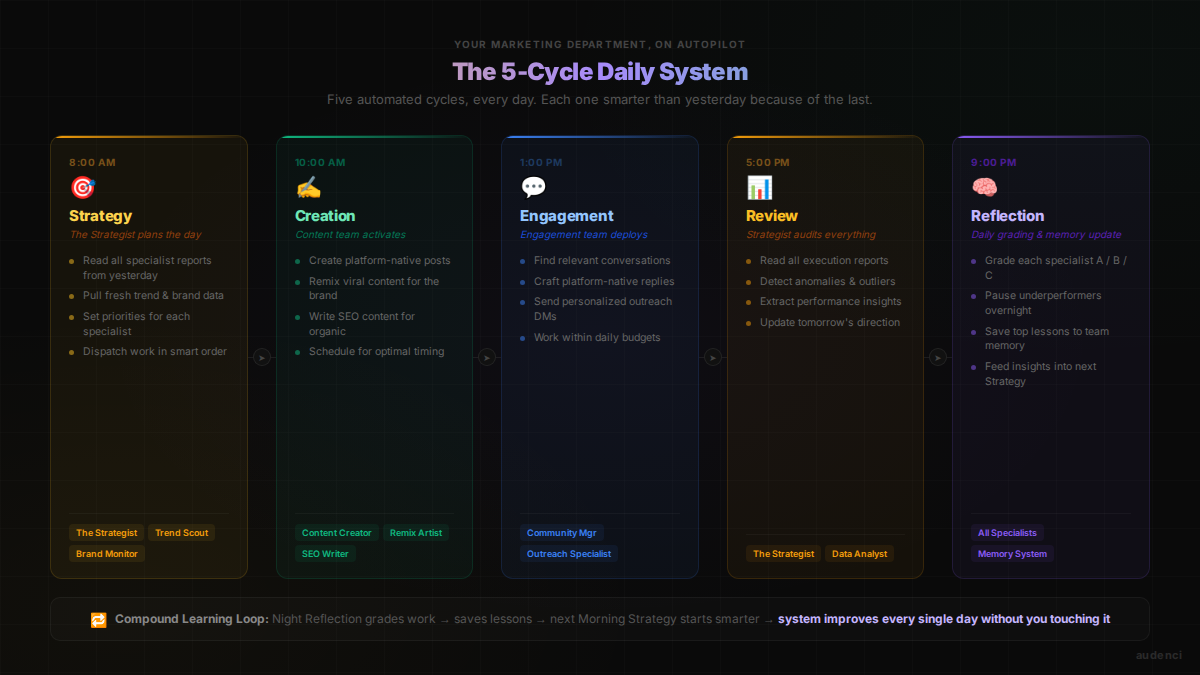
Here's what a day looks like when all 14 are running.
8 AM — Strategy. The Strategist reads everything from yesterday. Performance data, specialist reports, trend signals, brand mentions. It sets the day's priorities and dispatches work in order — intelligence specialists go first to gather fresh data, so content can build on it, so engagement can amplify it.
10 AM — Creation. The Content Creator, Remix Artist, and SEO Writer get their objectives and go to work. Posts get drafted, reviewed against brand guidelines, scheduled for the best publish times.
1 PM — Engagement. The Community Manager and Outreach Specialist activate with daily budgets. They work when audiences are most active, not when the algorithm makes it easy.
5 PM — Review. The Strategist reads every execution report from the day. Spots anomalies. Extracts insights. Updates strategies for tomorrow.
9 PM — Reflection. Every specialist gets graded: A, B, or C. C-grade performers get paused overnight. Top lessons get saved to team memory. The cycle feeds into the next morning's strategy.
The key thing: Review feeds Strategy. Every morning starts smarter than the last. This is how the system improves over time instead of running on repeat.
The Memory That Makes It Get Better
Here's the thing traditional tools don't have: institutional knowledge.
Every specialist remembers what worked. Not vaguely — specifically. "Carousel posts generate 3x engagement on Instagram" (high confidence, validated 24 times). "Questions in hooks drive more comments than statements" (medium confidence, still testing). "Text-only posts get traction on Tuesday afternoons" (fading — hasn't been confirmed recently).
Memories have confidence scores. They're validated when the evidence comes in. They decay when they're not used.
This last part is critical. Without decay, you accumulate stale knowledge that poisons future decisions. What worked two months ago might be completely wrong today. So memories that aren't validated expire. The cap is 50 per specialist — enough to hold real patterns, not so many that old noise drowns out new signal.
When The Data Analyst discovers that a particular content format dramatically outperforms others, that learning gets shared with The Content Creator and The Remix Artist automatically. The whole team gets smarter together.
This is what separates a system that runs from a system that improves.
One Brain, Five Platforms
The hardest part of solo marketing isn't any single channel. It's maintaining coherent presence across all of them simultaneously.
A 10-person team can put one person on each platform. You can't.
Here's how the team handles it:
The Strategist holds your brand context — voice, tone, content pillars, words to avoid, per-platform customization. Every specialist inherits that context before every task. The Content Creator writes Twitter text very differently from Instagram carousels. The Community Manager replies with Reddit's community norms in mind, not Twitter's.
The result: one brand, expressed correctly on every surface, simultaneously.
You don't write for Twitter and hope you have time for LinkedIn. The team writes for both. At the right time. In the right format. Without you touching it.
What This Looks Like in Practice
Let's say your Trend Scout surfaces a topic that's breaking in your niche.
Within the morning Strategy cycle, The Strategist evaluates it: high brand fit, rising fast, not too crowded. It dispatches The Content Creator with an objective — "create a post riding this trend, Instagram and Twitter formats, brand voice casual, don't be preachy."
The Content Creator builds both versions. Instagram gets a carousel with a strong hook slide. Twitter gets a punchy single-post take. Both get scheduled.
Meanwhile, The Community Manager gets dispatched to find conversations already happening about the same trend. It finds 8 threads worth engaging with and crafts platform-native replies for each.
By end of day, The Data Analyst is tracking performance on all of it. By 9 PM, The Strategist grades the work. If the Instagram carousel performed 3x better than average, The Content Creator logs that pattern. Next time a similar trend surfaces, it starts with the carousel format by default.
You did nothing. You got coverage on two platforms, in 10 conversations, with a brand-consistent voice, and a new memory in the system.
The Real Unfair Advantage
The 10-person team is working. They're producing.
But they're also in meetings, out sick, changing jobs, losing context when someone new joins, and running into creative blocks. They're human.
Your AI team runs five cycles every day. It never loses context. It never forgets what worked. It never needs a handoff document. It gets more focused over time, not less, because bad memories expire and good ones get reinforced.
The unfair advantage isn't volume. It's compound learning.
Every day, the team gets a little better at knowing what your audience responds to. A little sharper at spotting the right trends. A little more precise at timing. Individually, the improvements are tiny. Over three months, the gap between day one and day ninety is enormous.
That's what a 10-person team can't replicate on a human timeline. They can improve — but not compound. Every new insight requires a team meeting, a strategy update, a workflow change. The AI team just saves the memory and adjusts.
What Audenci Actually Is
We built Audenci because we were the founders we're describing.
We had a product. We couldn't staff up. We tried hiring and realized we couldn't afford the coverage we actually needed. We tried tools and realized tools don't coordinate — they just do one thing each.
So we built the team we couldn't afford to hire.
Audenci is that team. 14 specialists, organized exactly like a real marketing department, running five automated cycles every day. The Strategist sets direction. The specialists execute. The memory system compounds learning. The attribution system shows you exactly what drove what.
You set the brand context once. The team runs.
If you're a solo founder, or a two-person startup, or a bootstrapped team wearing too many hats — Audenci was built specifically for you.
Not because we think AI replaces people. But because the founders who need marketing most are exactly the ones who can't afford the team to do it.
Now they can.
Lessons Worth Keeping
A few things we learned building this that apply whether you use Audenci or not.
Specialize before you automate. One AI trying to do everything is worse than five focused ones doing their domains. Same applies to processes, tools, and people.
Memory without decay is noise. Any system that learns needs to forget the things that stopped being true.
Tell teams WHAT, not HOW. Objectives produce creative decisions. Instructions produce rigid scripts. Give your specialists — AI or human — a target, not a script.
Track cause and effect. "We posted 50 times this week" is a vanity metric. "This trend discovery led to 3 posts that generated 2 qualified leads" is signal. Build for signal.
Volume is not the advantage. Compound learning is. The team that gets a little better every day beats the team that works harder. Always.
The marketing department you can't afford to hire? You can build it.
You don't need ten people. You need the right 14.